
Training a Forward Deployed Engineer for Infrastructure Transformation
Why I built 'Forward Deployed Engineer: AI for the Infrastructure Estate' — course seven on AICademy. FDE method, infrastructure substance: embed with a client, assess the estate, then deliver and govern an AI change behind a human gate, across one accumulating 10-week engagement.
On this page
A course for the engineer who has to make AI land. How, and why, I built “Forward Deployed Engineer: AI for the Infrastructure Estate” — course seven on AICademy.
The dashboard nobody opened
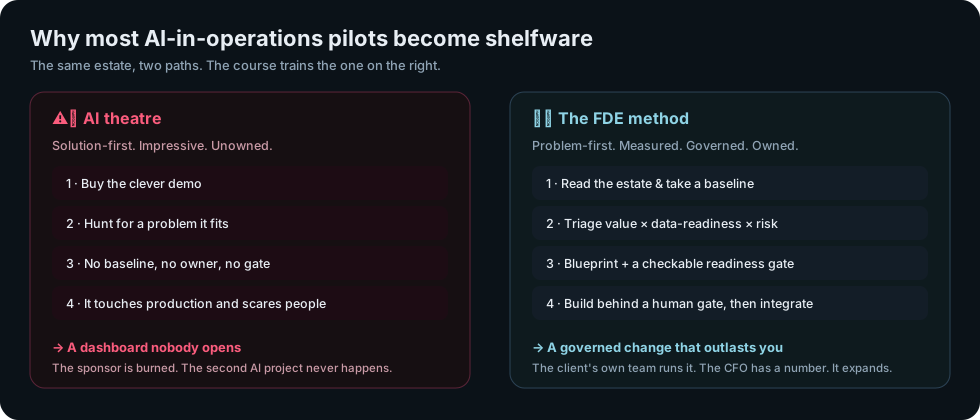
Every infrastructure leader I talk to has the same scar. Two years ago someone sold them an “AIOps platform.” There was a slick demo. There was a purchase order. And then there was a dashboard that nobody ever opened again.
That scar is the reason this course exists. Because the problem was never the technology — the models are good enough. The problem is that almost nobody is trained to take AI and actually land it inside how an organisation runs its estate: its datacenter, its network, its endpoints, its change control. Not advise on it. Not demo it. Land it — as a governed change that outlives the person who built it.
And the real cost isn’t the wasted licence. It’s the second-order one: the sponsor is burned, so the next AI project — the one that might have worked — never gets funded. Shelfware doesn’t just fail; it poisons the well behind it.
The role that does this has a name in the software world: the forward deployed engineer, or FDE. Someone who embeds with a client, builds with them, iterates against their real environment, and earns trust in weeks rather than slides. I wanted a course that trained that instinct — but for infrastructure people, on infrastructure substance.
The gap I kept hitting
When I went looking at existing FDE material, I found the same thing everywhere: it was all written for software engineers. Build a production AI app in Python. Wire up an agent framework. Ship a feature.
That’s a real skill — but it’s not the job of the person who runs a datacenter aisle, guards a change advisory board, or keeps 6,000 endpoints alive. Those people don’t need to train a model. They need to read an estate correctly, judge where AI genuinely earns its place, integrate it safely behind a human gate, and defend the outcome to a CFO and a CISO who are paid to be sceptical.
So I set the design principle that everything else hangs off:
FDE method, infrastructure substance.
The method — embed, assess, frame, deliver, govern, land — comes straight from forward deployment. The substance is entirely infrastructure: alert storms, config drift, capacity headroom, ticket deflection, data residency, blast radius.
How it actually started
This one didn’t begin with code. It began with a design document, then a second, then a third — each one arguing with the last.
The first draft was too close to the software-FDE courses I was reacting against. So I ran it past two rounds of external curriculum review and folded in what genuinely held up. Three changes mattered most, and you can see all three in the finished shape:
- A delivery-foundation module was missing. Infrastructure people are strong on estates and weak on agentic patterns — evals, guardrails, tool-calling, observability. If those first appear inside the estate labs, the labs collapse under the teaching load. So I inserted Module 5 as a dedicated “prepare the ground” phase: learn the delivery primitives once, then the estate modules apply them instead of drowning in them.
- Governance couldn’t be a module at the end. A CISO’s questions are the ones you should have asked first. So governance is threaded from Module 1 and only consolidated into a signable pack at Module 10.
- The readiness gate had to be real. Before any build, the learner writes their data-access assumptions, eval criteria and risk controls as statements a colleague can tick true or false. If you can’t, you’re not ready — and saying so is the senior move.
Only once that was locked did I build the runtime course into the platform.
The journey: the decisions that shaped it
One client, ten weeks, one accumulating engagement. I didn’t want ten disconnected exercises. The whole course runs against a single fictional client — Cranfield Group, a mid-market distribution and manufacturing firm with two datacenters, an SD-WAN across 42 sites, a 70%-trustworthy CMDB, and a sponsor who’s been burned before.
And it pushes back. A six-person cast has its own agenda: the scarred sponsor who has heard this pitch before; the change-control lead whose “no” is usually right; the CISO with two hard lines she will not move; the eager service-desk manager who wants it now; the CFO holding a competing quote; and your own delivery lead, who cares less about this engagement than about whether it produces a repeatable play. You don’t work around them — you earn each one. That cast is what turns a syllabus into a simulation, and it’s the difference between learning a framework and rehearsing a job.
Every module adds one artifact to a single engagement pack, defended to that room in Week 10.
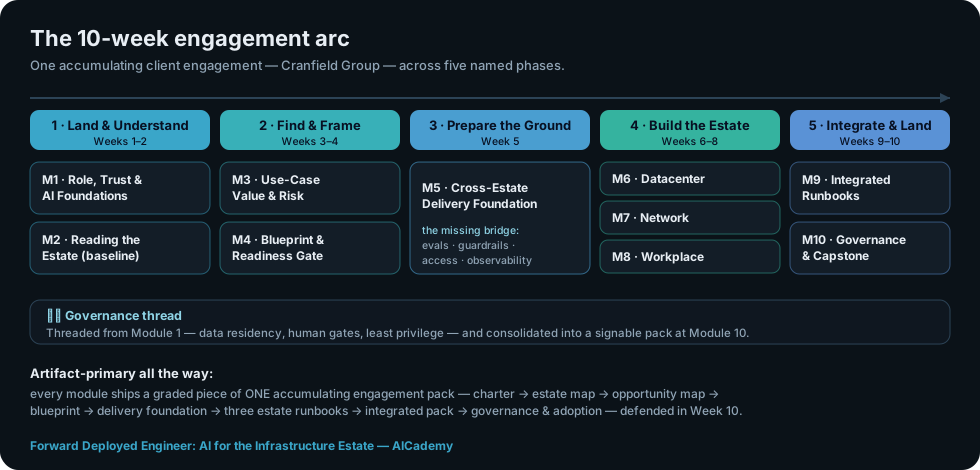
Artifact-primary, not quiz-primary. The graded deliverable each week is the artifact — the charter, the estate map, the blueprint, the runbook — because that’s what the job actually is. The quizzes are a lighter formative check.
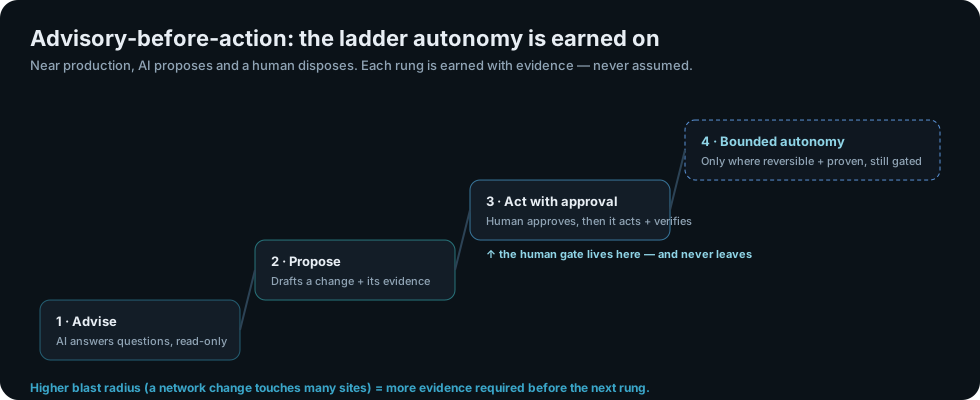
Advisory-before-action, everywhere. The single most important habit the course drills is that near production, AI proposes and a human disposes. Autonomy is earned rung by rung, with evidence, and the human gate never leaves. On a network change that can take down 42 sites, that boundary is the whole thing.
A detail I’m quietly proud of. Across the platform I’d noticed a subtle flaw: on multiple-choice questions, the correct answer was almost always the longest option — a tell a savvy learner could game without knowing the material. For this course I fixed it at the source. All 120 questions were authored length-neutral from the start: the correct answer sits at each length rank exactly a quarter of the time. Measured across the whole course, “pick the longest” and “pick the shortest” both land at 25.0% — pure chance. You can’t game these; you have to know the answer.
I also gave it its own identity: a steel-and-signal-cyan “estate” theme — the cool blue-grey of a datacenter aisle and a NOC screen — checked to be visually distinct from every other course on the platform.
What a learner walks away with
Not a certificate and a vague feeling. A portfolio — one accumulating, defended engagement pack:
- An engagement charter and a sealed Day-One baseline (reopened at the end, so you can see how your own thinking changed)
- A rated estate map, data inventory, and a measured before-baseline
- An opportunity map scored on value × data-readiness × risk, with quantified KPI hypotheses
- A solution blueprint and a checkable readiness gate
- A reusable delivery foundation (evals, guardrails, access, observability)
- Three estate runbooks — datacenter, network, workplace
- An integrated, production-ready agentic runbook behind a human gate
- A signable AI-in-operations governance pack, an ROI measured against the baseline, and a 90-day land-and-expand plan
Plus eight reusable toolkits — the scoring sheet, the blueprint template, the failure-modes library, the production-readiness checklist — that you keep and reuse on your next real engagement.
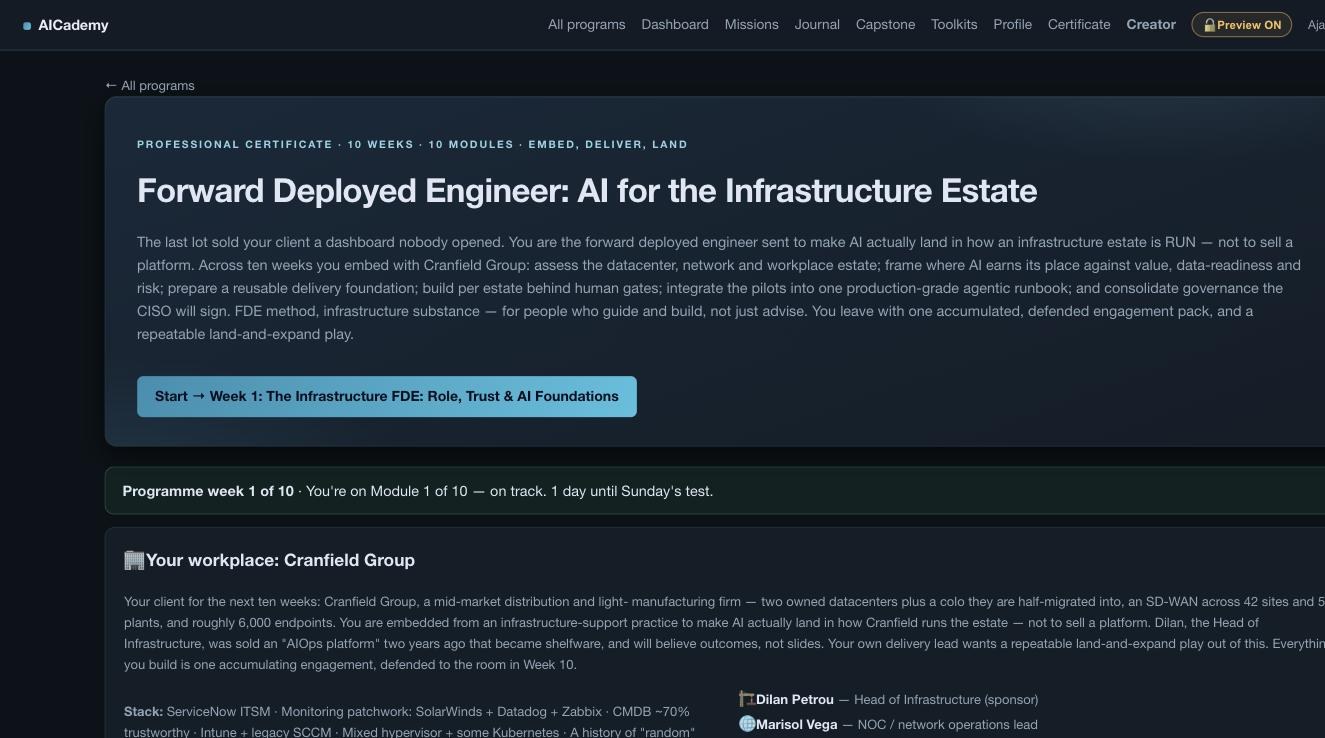
Day one on the Cranfield account. The brief is on the dashboard, not in a syllabus — two datacenters, 42 sites, a sponsor who was sold “AIOps” two years ago and got shelfware.
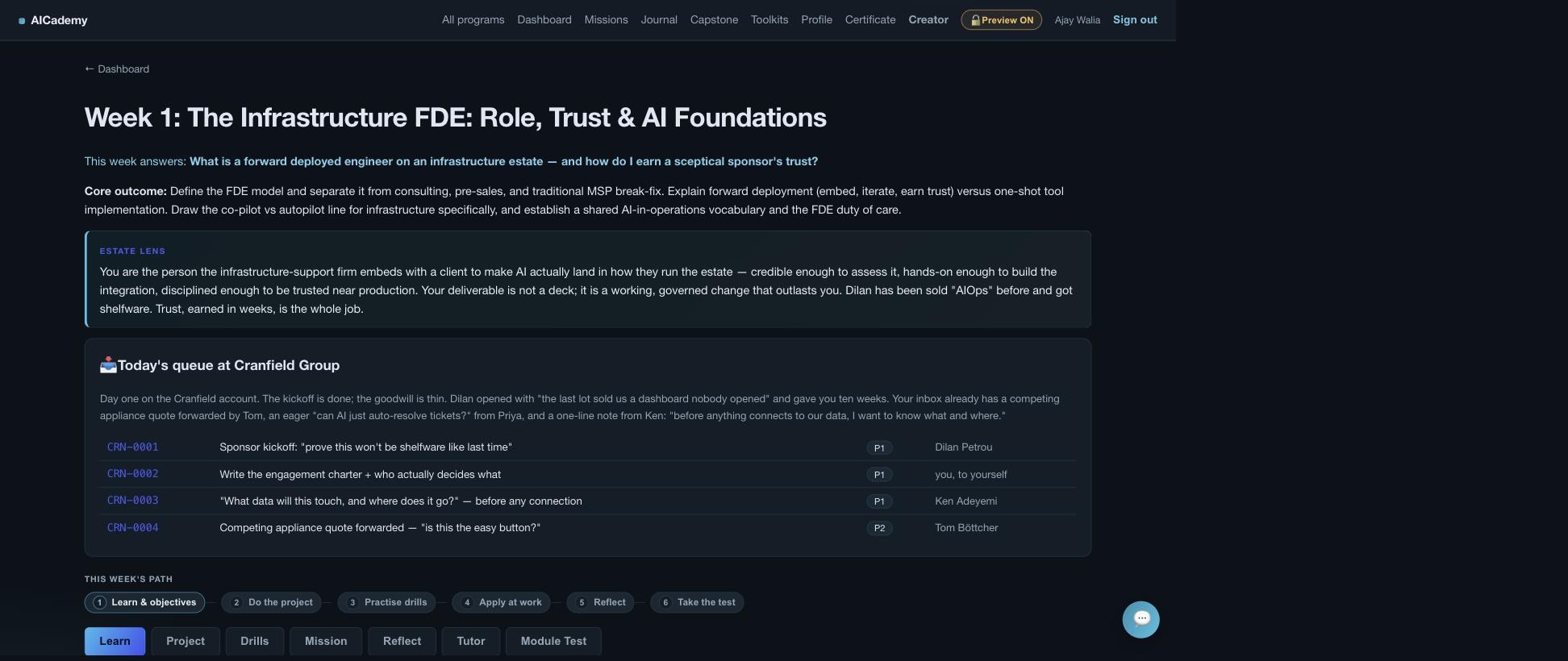
Week 1. The Estate lens reframes the concept in the learner’s own language, and “Today’s queue at Cranfield” is the week’s real work: a sceptical sponsor kickoff, the charter, the CISO asking what data this touches before anything connects, and a competing appliance quote already forwarded by the CFO.
Who it’s for (and who it isn’t)
Most effective for: infrastructure and platform engineers, MSP and field/solutions delivery leads, and ops leads who are being asked to bring AI into how a client or their own organisation runs — people who have to guide and build, not just advise. Solid infrastructure experience is assumed; no machine-learning background is required.
Not the right fit if you want to train or fine-tune models, or you’re after a pure software-engineering “build an AI app” track. This course is about landing AI into operations safely — a different job.
Try it
The course is live now, free to browse, as course seven on AICademy:
→ ragentic.netlify.app · jump straight to the course: Forward Deployed Engineer: AI for the Infrastructure Estate
If your last AI project became a dashboard nobody opened, this is the course about making sure the next one doesn’t.
Written by Ajay Walia. AICademy is my collection of focused, hands-on, contextual AI programs — built for people in the IT infrastructure domain. Seven courses, 92 modules, free.

About the Author
Ajay Walia
AI {IT Architect} focusing on local-first multi-agent AI engineering, zero-data-egress systems. Ideator, Creator and Executor on Curious Bit.
Keep Reading

An AI Academy for the People Who Keep the Lights On (Part 1)
AICademy: six hands-on AI courses and 82 modules built for infrastructure support engineers at GSIs like TCS, HCL and Infosys. The philosophy, the stack, the courses, and why it's different from every AI course online today.

Six Fixes and One Honest Half-Measure (AICademy Part 2)
A rebuild log for AICademy: the six upgrades I shipped after a code review — scroll restoration, empty-state removal, lazy loading, a week's-path checklist, catalog wayfinding and worked examples — the two findings I declined, and the performance fix I deliberately left half-done.

Choose Your Path — Five AI-Augmented Careers, One Academy
A visual guide to AICademy's five hands-on paths — Service Desk, SysAdmin, IT Project Manager, RAG Engineering, and Agentic AI Leadership — and how to pick the one that matches the job you already do.