
From FTEs to Agentic Workflows — Reshaping Infrastructure Outsourcing
A six-minute executive briefing on the architectural and commercial shift underway in Indian infrastructure outsourcing. Where the industry sits on the automation maturity curve, why the incentive conflict is harder than the technology, and what one fictional 80,000-endpoint bank account looks like over a 24-month rollout. Companion to the long-form analysis.
On this page
A six-minute companion to the long-form analysis. Read this if you have ten minutes and a calendar full of other meetings. Read the long-form if you have an hour and a strategy decision to make.
The 30-Second Version
Uber’s engineering team has published material describing a working internal platform that, by their own numbers, supports around sixty thousand weekly AI tasks flowing through a single governed gateway, with around ten thousand internal services exposed as agent-callable tools. The architectural pattern — a Model Context Protocol-centred fabric with a tool registry, central governance and auto-converted tool wrappers — is reproducible. The protocol is open.
Indian IT outsourcing — TCS, Infosys, Wipro, HCLTech, LTIMindtree, Cognizant, Tech Mahindra, Mphasis, Coforge — is the natural beneficiary of the same architecture applied to client estates rather than a single internal estate. The decisive question is not whether to build the platform. It is whether the firms that build it have the commercial nerve to convert the technical capability into a different deal shape. The technology is the easy part. The conversation about who gets paid is harder.
This brief covers the three things that matter most for an executive reading on a Tuesday: where the industry sits on the maturity curve, why the incentive conflict is the real constraint, and what the rollout looks like on a real account.
Where The Industry Sits On The Curve
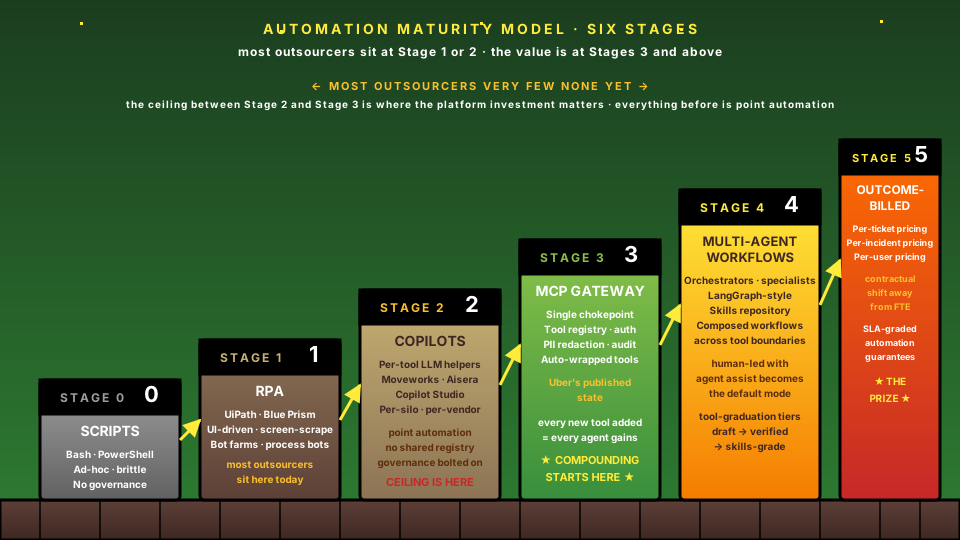
Most outsourcers operate large client accounts at Stage 1 or Stage 2 today. RPA bots and per-tool copilots are useful, but they are point automation — each new tool or workflow improves one workflow. They do not compound.
Stage 3 is where compounding starts. An MCP-centred gateway with a tool registry, central governance, and auto-converted tool wrappers means every new tool exposed makes every existing agent more capable. The investment shape changes from “build a copilot” to “build a platform that produces copilots”. This is the published state inside Uber.
Stages 4 and 5 are where the commercial model shifts to outcome-billed delivery. Nobody is there at scale yet.
The honest gap from Stage 2 to Stage 3 is two to four quarters of platform work plus an unglamorous data-hygiene investment — CMDB cleanup, knowledge-base curation, ticket-taxonomy normalisation. The gap from Stage 3 to Stage 5 is not technical at all. It is the incentive problem.
The Incentive Problem Is The Real Constraint
This is the part of the thesis that gets understated in most conversations, including the original long-form draft of this analysis.
Outsourcing revenue is FTE-shaped. Contracts are priced as a stack of named roles multiplied by billing rates and headcounts. Reduce the headcount required to deliver a service and the immediate effect is a smaller bill to the customer. That is revenue cannibalisation, and it cuts against the platform business case.
The same effect applies inside the firm. A tower lead’s standing is shaped partly by tower size. A practice head’s position is shaped partly by billable headcount. The people who would have to champion the platform are also the people whose internal position it weakens. This is not a moral failing — it is rational behaviour given how the firm rewards them.
Four commercial paths through this, each failing in a different way.
Productivity dividend. Keep the FTE count, use the gains to expand scope or absorb new work without growing the team. Lowest internal resistance. Often produces no measurable customer benefit and therefore no commercial differentiation.
Margin retention. Hold the customer price, reduce delivery cost through automation, retain the margin. Works in shorter contracts. Creates trust issues at renewal — customers eventually see the AI talking points elsewhere and ask why they are paying yesterday’s price for tomorrow’s delivery model.
Outcome repricing. Move new contracts to per-ticket, per-incident or per-user pricing. The structural prize. Requires the commercial nerve to renegotiate large contracts, and the conversation is uncomfortable.
Productivity-billed sharing. Open-book pricing where automation gains are explicitly shared between vendor and customer. Mature, durable, hard to negotiate. Only viable in the small minority of high-trust accounts.
Customers also resist — not all, but a meaningful share — particularly in regulated industries, in accounts with hard data-sovereignty constraints, and where the customer’s own IT organisation has a vested interest in keeping the outsourcer’s headcount visible.
The firms that win will build the platform and have the commercial conversation. The firms that build the platform without the conversation will end up with a quietly impressive internal capability that does not show up in revenue.
What This Looks Like For A Real Account
A composite client. Eighty thousand endpoints across thirty countries. Around four hundred and fifty named FTEs across all towers (a typical 1:175 endpoint-to-FTE ratio). Around ninety-five thousand monthly tickets, of which roughly forty-two thousand are repetitive L1 categories. Five-year contract with a single Indian outsourcer. Moderate CMDB hygiene. Well-maintained ServiceNow; inconsistent integration with endpoint management.
Phase 1 (months 0–3). MCP gateway stood up. Three tools exposed: ServiceNow, Active Directory, Intune. One agent built: L1 password-reset and account-unlock automation. No-code builder wired. Baseline measured. Six gateway calls per minute by week ten.
Phase 2 (months 3–9). Orchestrator agent and VDI-triage workflow live. SCCM, Splunk, vSphere, NetBackup exposed. Fifteen SDMs and twenty senior engineers trained on the builder. L1 auto-resolution stabilises around 22 percent. Headcount has not changed yet, but queue depth has dropped by around 30 percent and customer satisfaction has lifted by single-digit points.
Phase 3 (months 9–18). Onboarding workflow live. Emergency patch workflow live. Asset and license reconciliation agents live. L1 auto-resolution stabilises around 32 percent. The customer asks why the monthly report has improved so visibly. The renewal conversation opens.
Phase 4 (months 18–24). Renewal lands on a hybrid commercial model — partial FTE billing plus a per-ticket envelope. Around four percent of the original FTE base is redeployed to other accounts. Another eight percent shifts to higher-value advisory work. The remainder continues in delivery roles. The vendor’s blended margin on the account improves by approximately two to four percentage points despite a lower headline contract value. Customer-side, cost-per-incident reduces by around 18 to 22 percent.
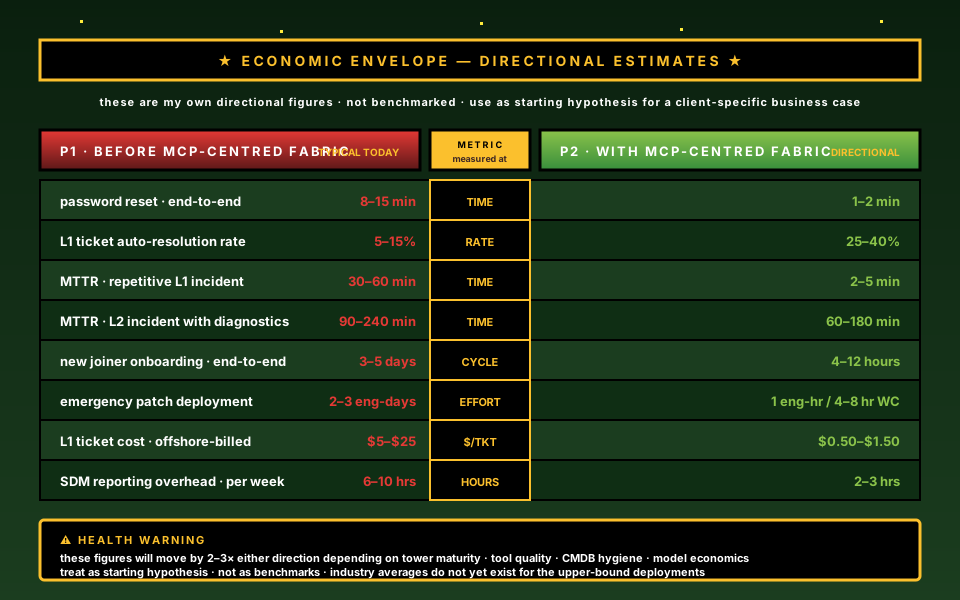
The metrics that actually decide success are not the headline ticket numbers. They are the renewal terms and the redeployment ratio. The renewal tells you whether the platform investment converted into a defensible commercial position. The redeployment ratio tells you whether the firm managed the internal political conversation well enough to keep its experienced people inside the business.
The bank is fictional. The numbers should be read as illustrative.
What To Do This Quarter
Three concrete actions for the executive reading this with a calendar full of other meetings.
One. Pick a single client account and a single process. Stand up an MCP-centred gateway against it. Two-quarter timeline. Real money — somewhere between $500K and $2M depending on starting position and tool count. Password reset and account unlock are the canonical starting workflows because the volume is enormous and the failure modes are well-understood.
Two. Open the commercial conversation in parallel with the technical build. Do not wait for delivery. Renewal cycles are long, and the conversation about deal shape needs months of customer education before it can convert. The technical platform and the commercial repositioning are two sides of the same investment.
Three. Pick the right SDM and the right tower lead to champion the rollout. The wrong choice will produce technical success and commercial failure. The internal politics of automation are as important as the architecture — possibly more.
Where To Go Deeper
The full analysis — protocol-versus-platform distinction, competitive landscape, role taxonomy, three concrete workflows in detail, the risks landscape, the five-phase rollout path — is in the long-form companion piece: From Service Desk to Agent Fabric.
The work that distinguishes the firms that win from the firms that wait is the execution discipline applied to both halves of the problem. The platform is the easier half. The conversation about who gets paid for the productivity is the harder half. Both must happen at the same time.
Test what you read
Quick quiz

About the Author
Ajay Walia
AI {IT Architect} focusing on local-first multi-agent AI engineering, zero-data-egress systems. Ideator, Creator and Executor on Curious Bit.
Keep Reading
From Service Desk to Agent Fabric — MCP Playbook and the Future of Indian IT Outsourcing
Uber has moved Model Context Protocol from a pilot into a standardised internal platform that, by their own published figures, supports tens of thousands of weekly AI tasks across their internal service estate. This piece dissects what they appear to have built, what it changed, and — at greater length — what the same pattern could plausibly enable for Indian IT outsourcing in the infrastructure space. It separates what Uber publicly described from my own extrapolation, places the architecture in a six-stage maturity model, addresses the political and commercial incentive conflicts that make the rollout much harder than the diagrams suggest, and walks through one fictional 80,000-endpoint bank to make the economics concrete.
Training an Agent on Public Vendor Data — A BigFix Workspace+ Case Study
How to build a contextual technical-support and architecture agent that is meaningfully better than a general LLM at one product, using nothing but publicly available vendor documentation. A walk-through of a working BigFix Workspace+ POC, the design decisions behind it, and the pattern that generalises to any vendor.

Essential Skills for the AI Era — What former British PM Says You Actually Need
AI is reshaping every job. The World Economic Forum, McKinsey, and peer-reviewed research agree on 17 skills that will define who thrives. Here they are — with how to build each one.