
Essential Skills for the AI Era — What former British PM Says You Actually Need
AI is reshaping every job. The World Economic Forum, McKinsey, and peer-reviewed research agree on 17 skills that will define who thrives. Here they are — with how to build each one.
On this page
Automation isn’t coming. It’s already here — and it’s accelerating faster than most organisations have planned for.
In the past two years, generative AI has moved from a novelty to a core part of how knowledge work gets done. Writing, coding, analysis, summarisation, customer interaction — tasks that once required specialists can now be initiated with a prompt. The World Economic Forum estimates that 85 million jobs will be disrupted by 2025, while 97 million new roles will emerge that require humans and machines to work together.
The uncomfortable truth is that the skills that made someone valuable in 2020 are not sufficient for 2030. Not because the work is disappearing entirely — but because the baseline has shifted. The tasks AI handles well are the ones most easily measured, most easily automated. What remains irreducibly human — and what organisations are now actively hiring for — are harder to fake, harder to code, and harder to scale.
The research is consistent across sources: the World Economic Forum Future of Jobs 2025 report, McKinsey’s workforce transition analyses, and a growing body of peer-reviewed evidence all point to the same cluster of capabilities. Not technical skills alone. Not soft skills alone. A specific combination of cognitive, interpersonal, leadership, and AI-fluency skills that together define effectiveness in an AI-augmented world.
This article walks through all 17 of them — drawn from a research-validated framework built on those primary sources — with enough detail to understand what each skill actually means and where to start building it.
The Framework: Four Categories, 17 Skills
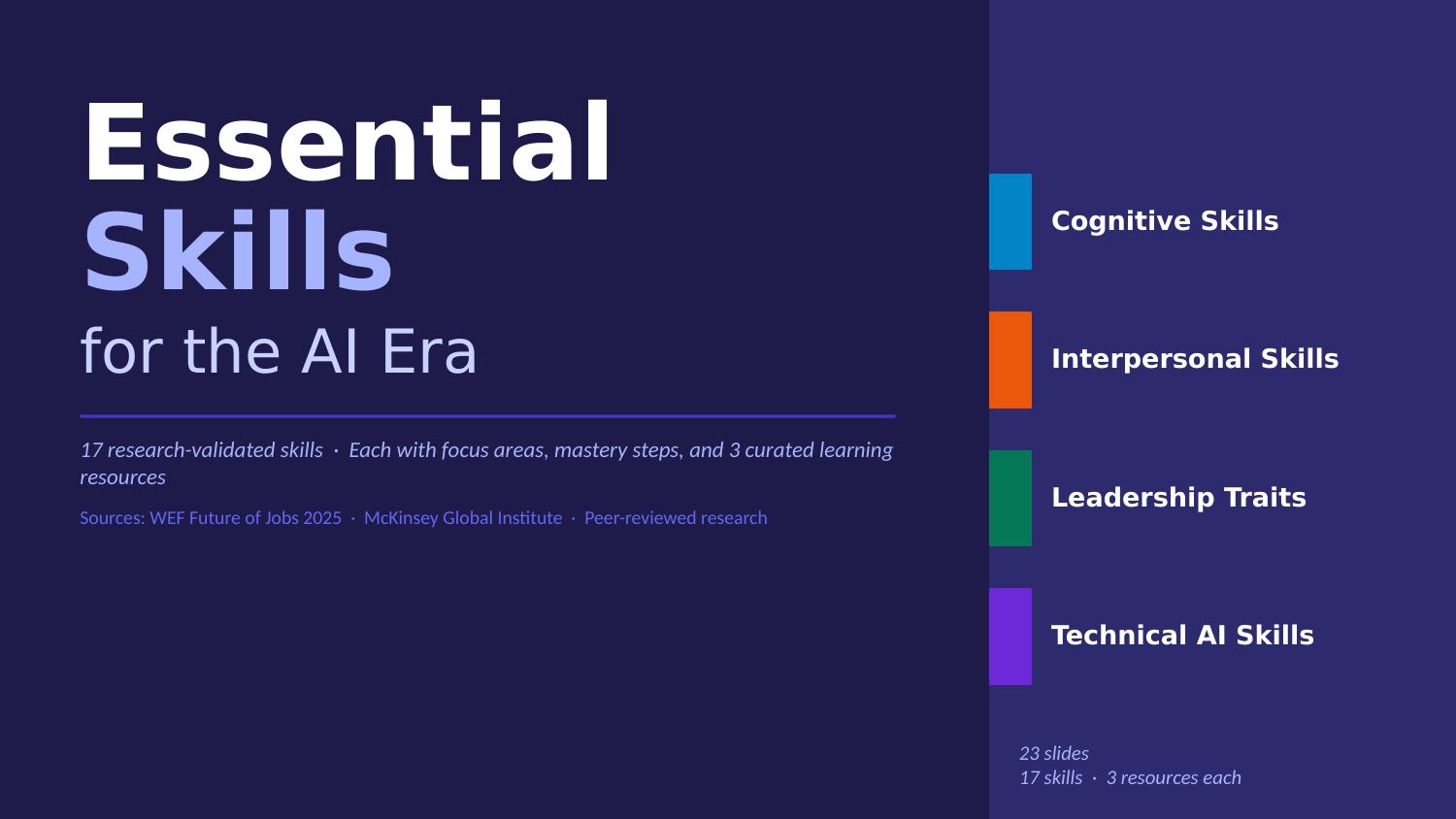
The 17 skills fall into four categories: Cognitive Skills, Interpersonal & Human Skills, Leadership & Character Traits, and Technical AI Skills. The split is intentional — effective performance in an AI-integrated workplace requires all four working together. Technical fluency without critical thinking produces prompt-execution without judgment. Interpersonal strength without resilience collapses under constant change. Leadership without integrity erodes trust at exactly the moment organisations need it most.
Part 1 — Cognitive Skills
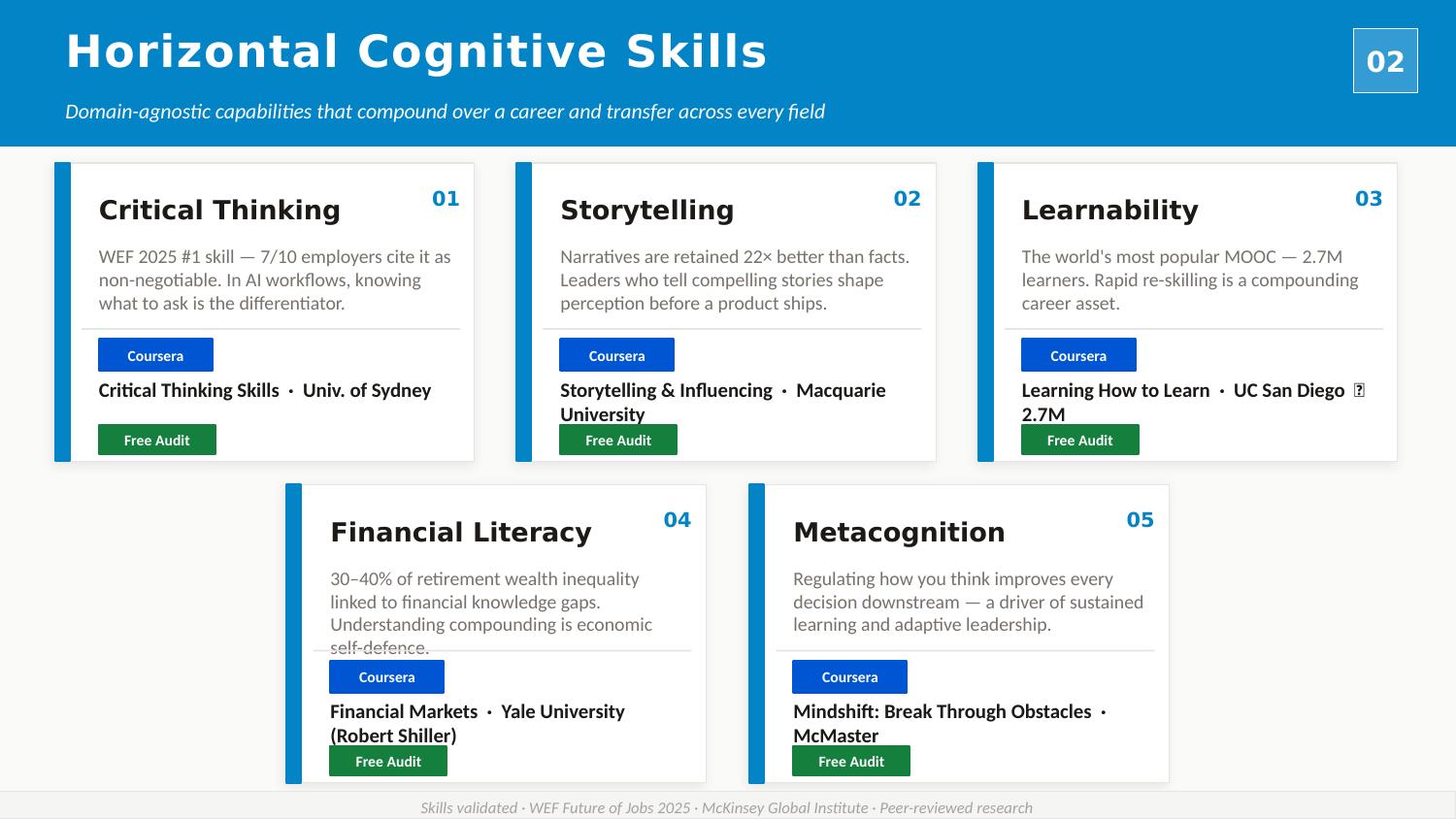
Five cognitive skills define how you process information, communicate insight, and keep pace with change. These are the mental habits that determine whether you use AI as a tool or become dependent on it without understanding what it produces.
Critical Thinking
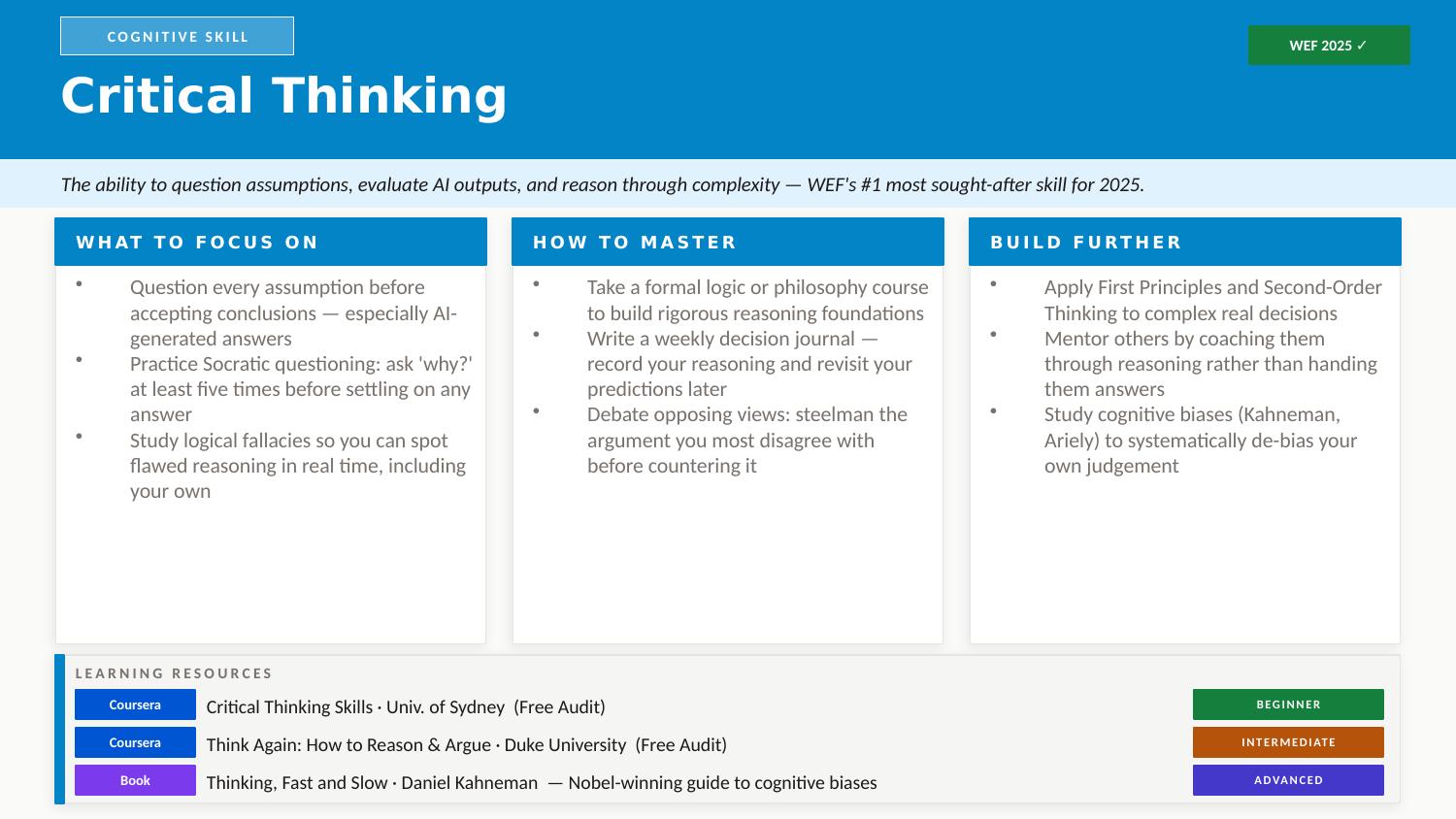
Critical thinking is the ability to analyse information objectively, identify assumptions, evaluate evidence, and reach reasoned conclusions — independent of what an AI, a manager, or a source claims. In an environment where AI can produce confident-sounding content that is factually wrong, this skill is no longer optional. The person who can interrogate an AI output, spot the flaw in a logical chain, and decide what actually holds up is the person who adds value above the model.
Storytelling
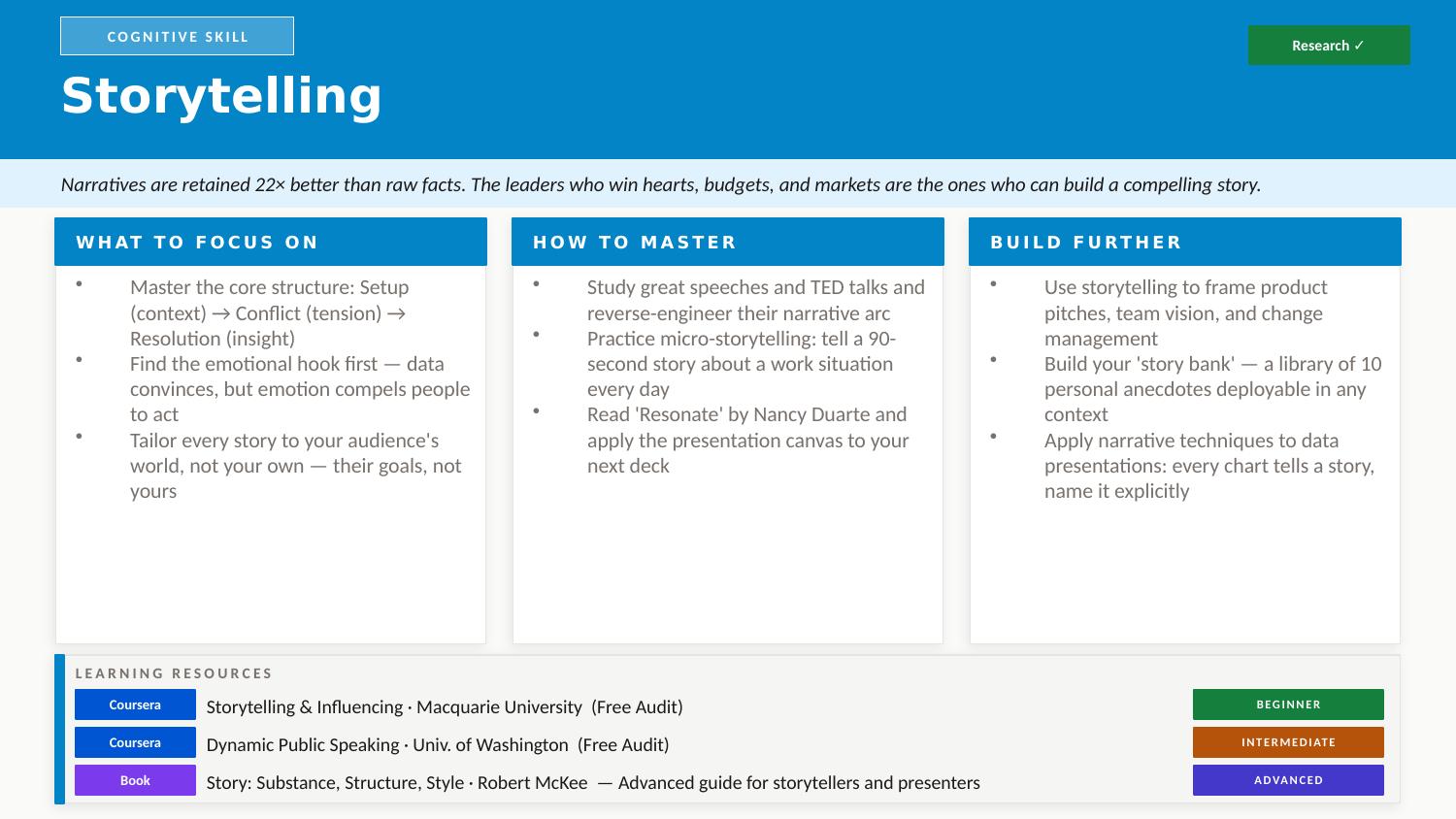
Data without narrative is noise. Storytelling is the capacity to take complex, technical, or ambiguous information and shape it into a form that moves people to understand and act. AI can draft a summary — it cannot yet understand which detail changes a room. The ability to read an audience, choose the right frame, and make information land is a persistent human advantage.
Learnability
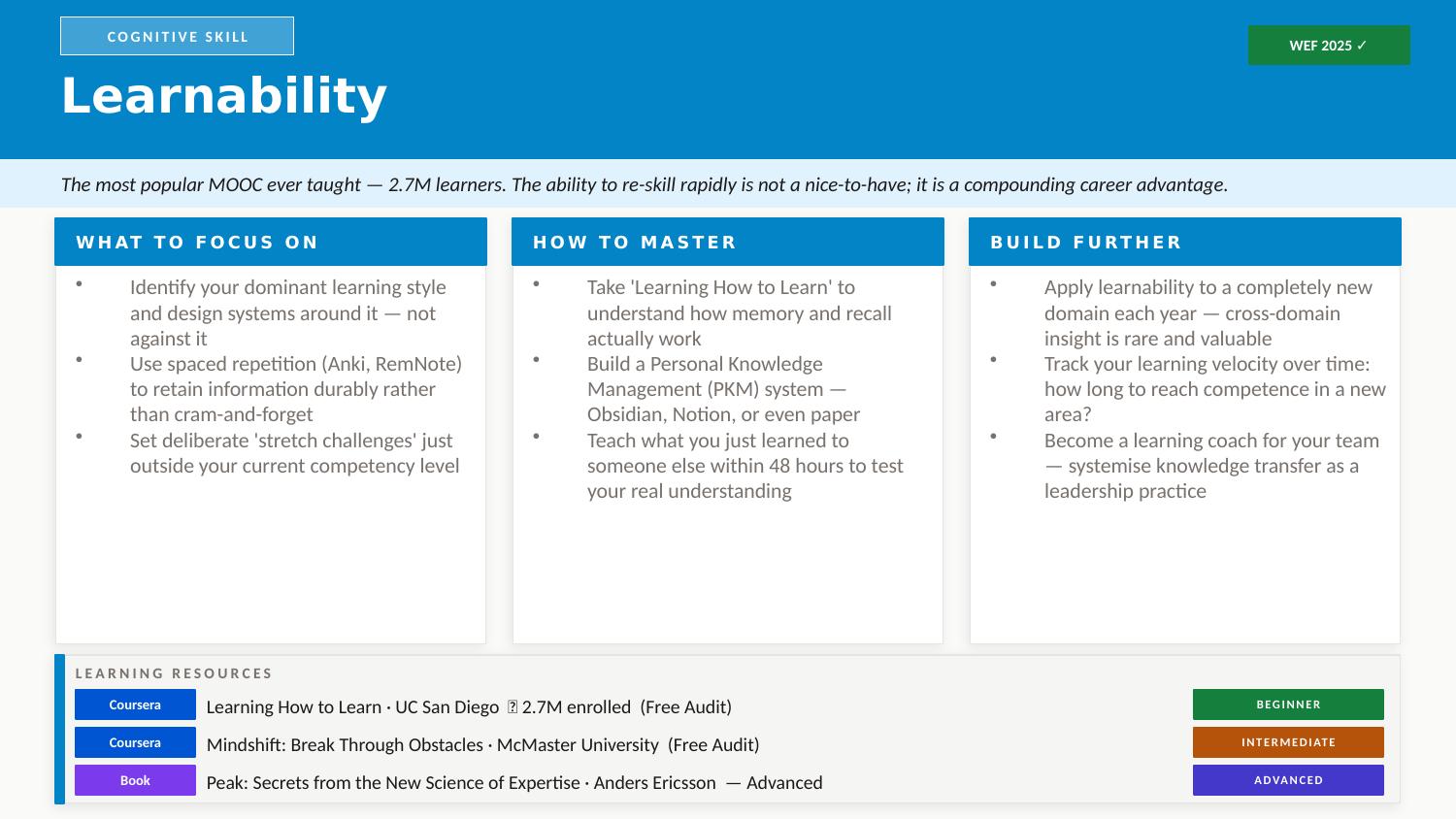
Learnability is the drive and ability to continuously acquire new skills as conditions change. The half-life of technical knowledge is shortening — what was cutting-edge 18 months ago is now a commodity. The differentiator is not what you currently know but how quickly you can absorb, apply, and discard what you need. This is a learnable habit in itself: building structured routines around learning, reflection, and experimentation.
Financial Literacy
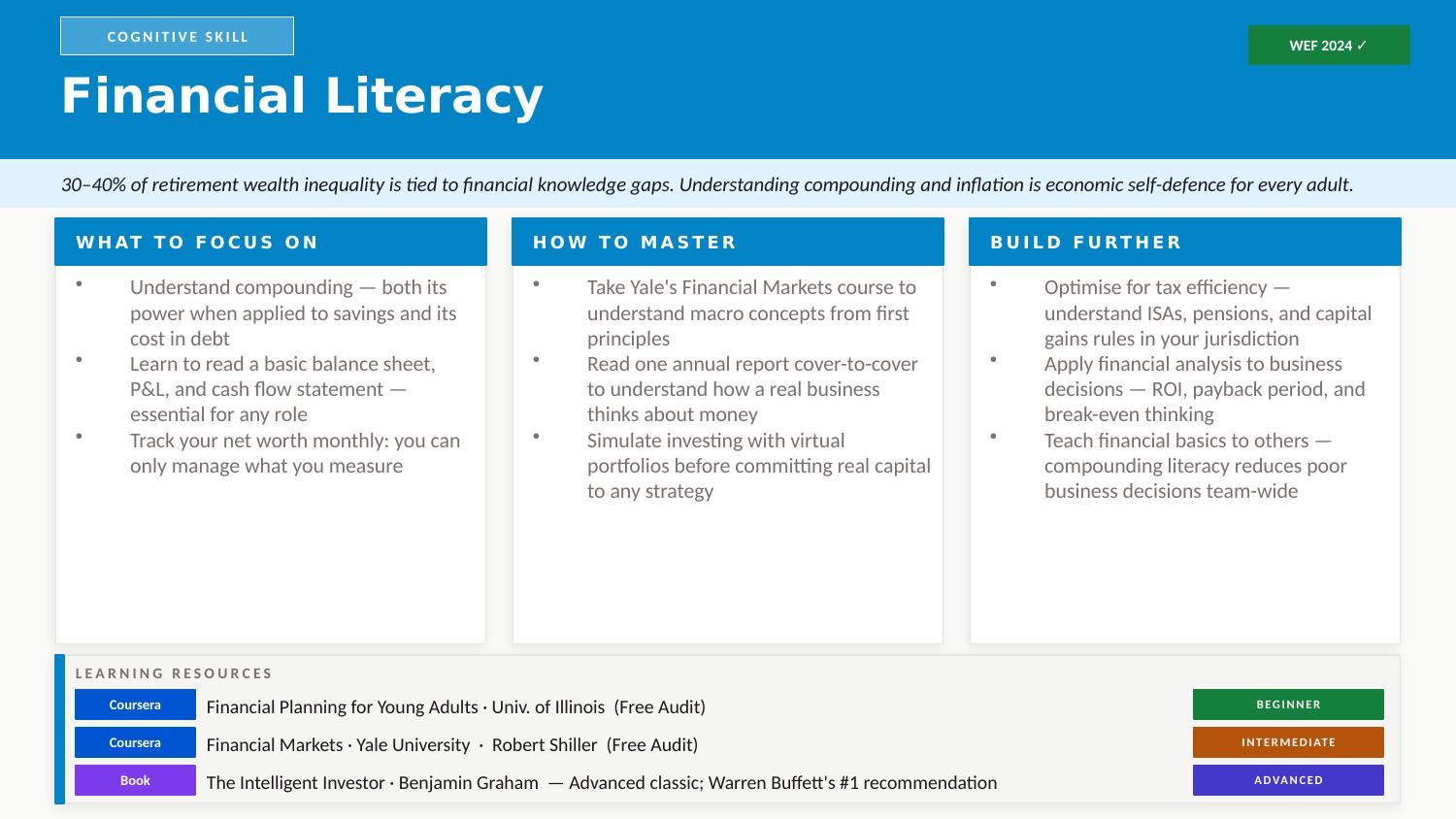
Financial literacy in this context means understanding the business logic behind decisions — how resources are allocated, how ROI is calculated, what the cost of inaction looks like. As AI tools proliferate, more people in non-finance roles are being asked to build business cases, evaluate vendor proposals, and justify investment. The person who can read a P&L and understand what it signals is better positioned to influence outcomes.
Metacognition
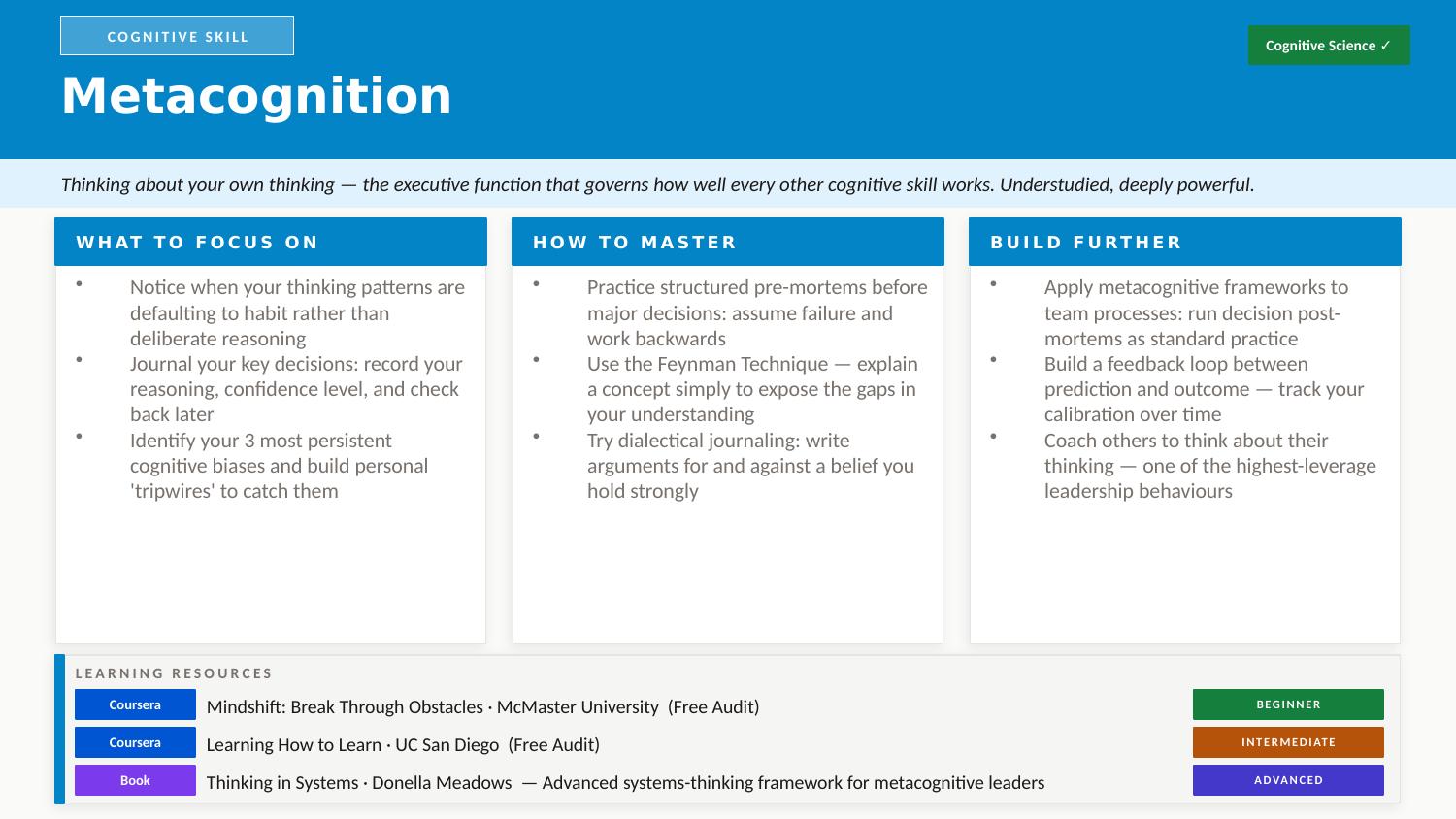
Metacognition is thinking about your own thinking. It’s the ability to notice when your reasoning is flawed, when a cognitive bias is operating, when you’re avoiding an uncomfortable conclusion. In fast-moving environments with incomplete information, this self-awareness separates people who course-correct early from those who double down on bad decisions. It’s also the foundation for using AI well — recognising where your own knowledge ends and where you need to verify.
Part 2 — Interpersonal & Human Skills
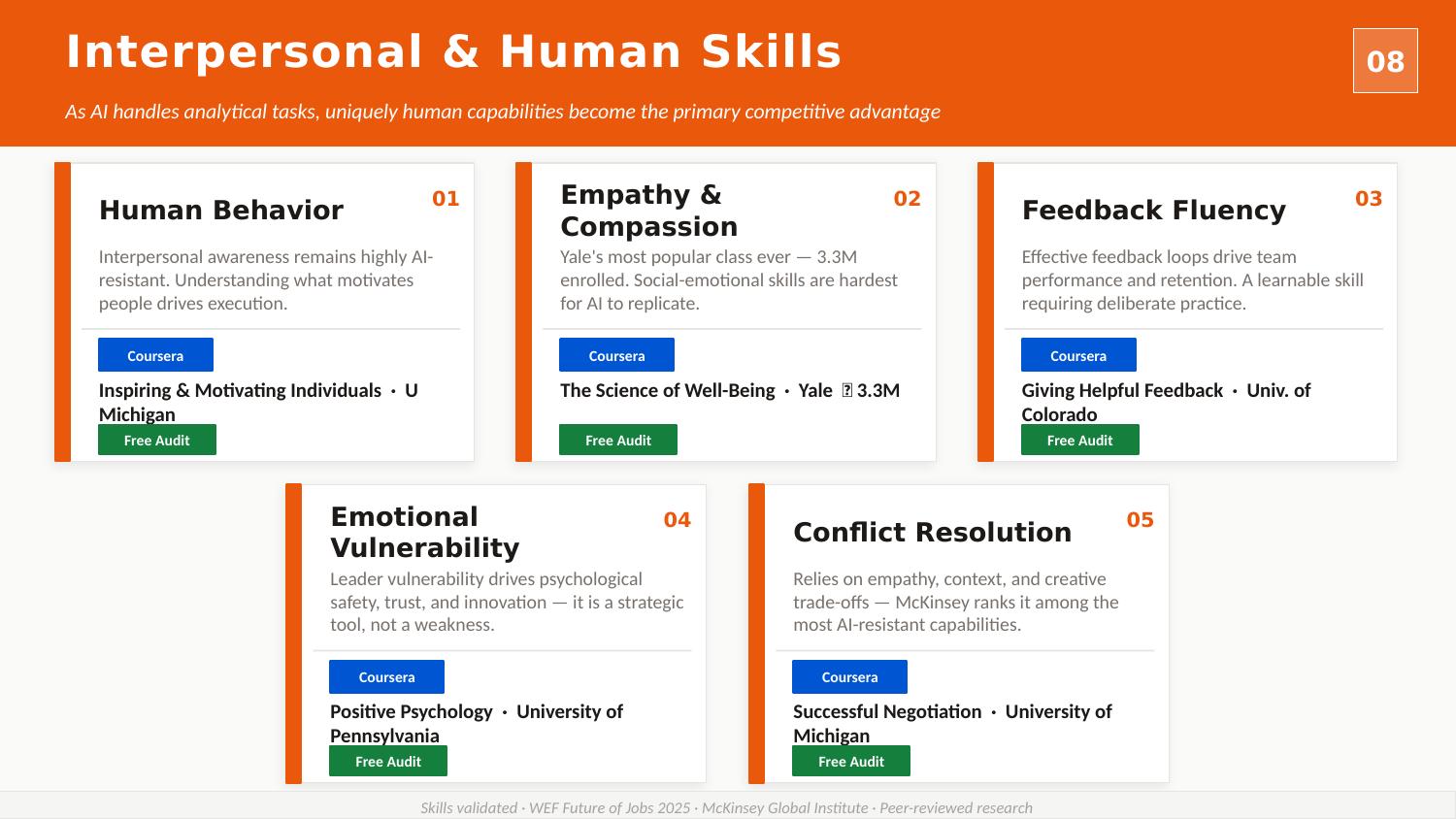
Five interpersonal skills define how you operate in relationship with others — colleagues, clients, teams, and the people impacted by your decisions. These are the skills most resistant to automation because they depend on presence, trust, and genuine human connection.
Human Behaviour
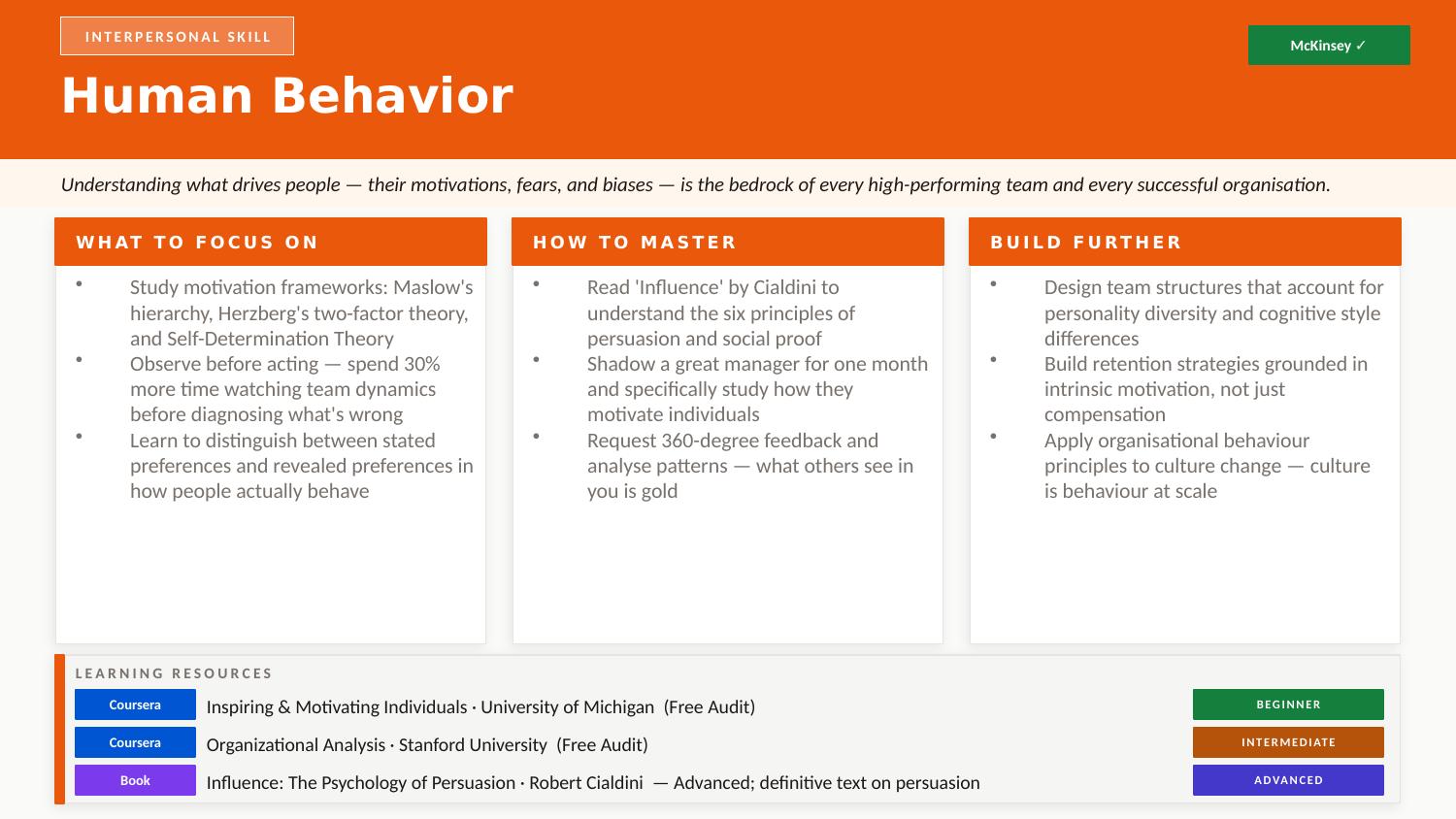
Understanding human behaviour — what motivates people, what creates resistance, how group dynamics operate — is the basis for effective collaboration, change management, and leadership. AI can analyse sentiment at scale; it cannot read the room in a difficult meeting or sense when a team is quietly disengaged. This skill is about developing the perceptual vocabulary to see what’s actually happening between people.
Empathy & Compassion
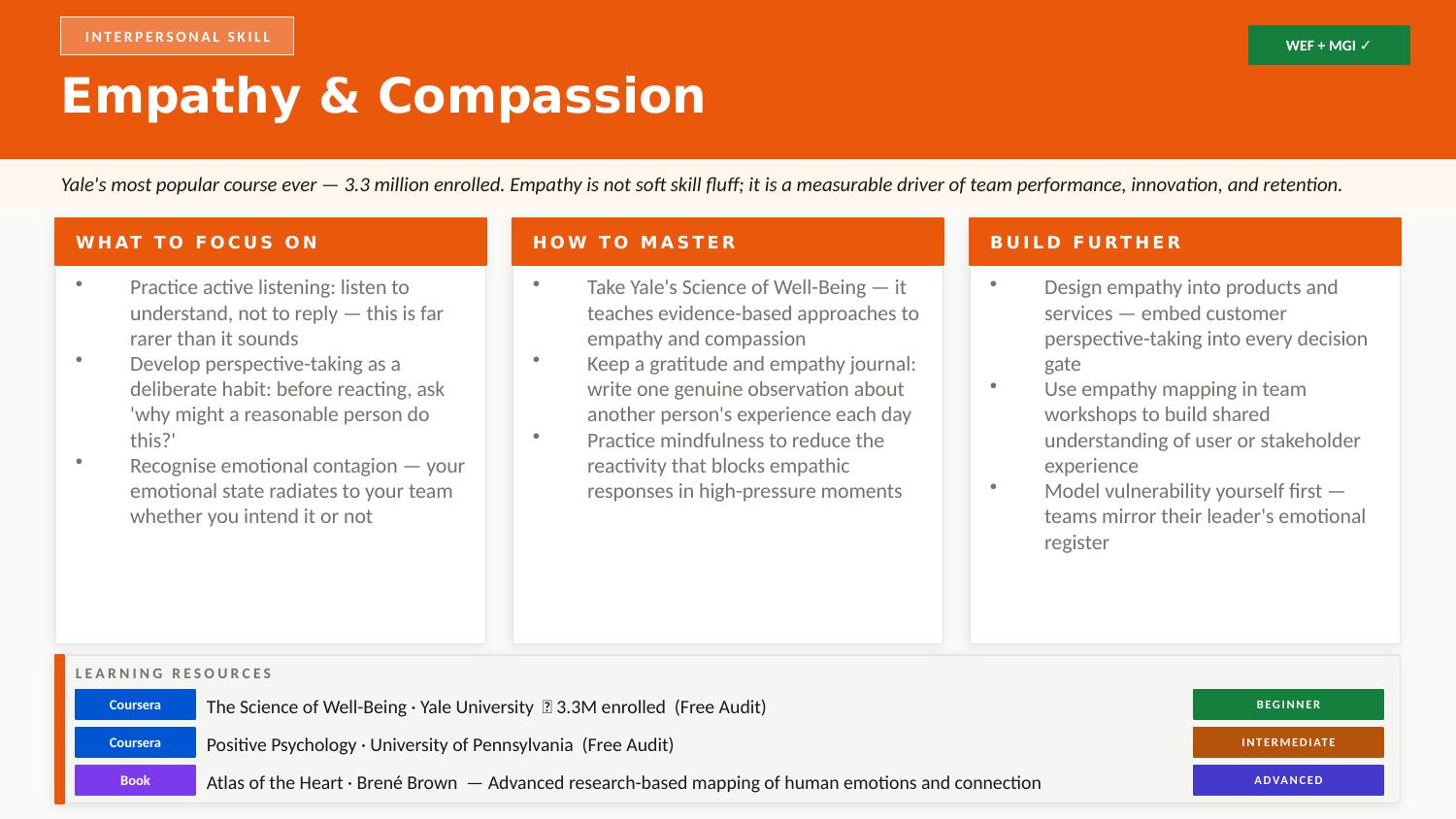
Empathy is not softness — it is a strategic capability. The ability to genuinely understand another person’s perspective, priorities, and constraints leads to better decisions, stronger relationships, and more effective communication. In a world where AI handles routine interactions, the interactions that remain human are the ones that matter most — and they require real presence.
Feedback Fluency
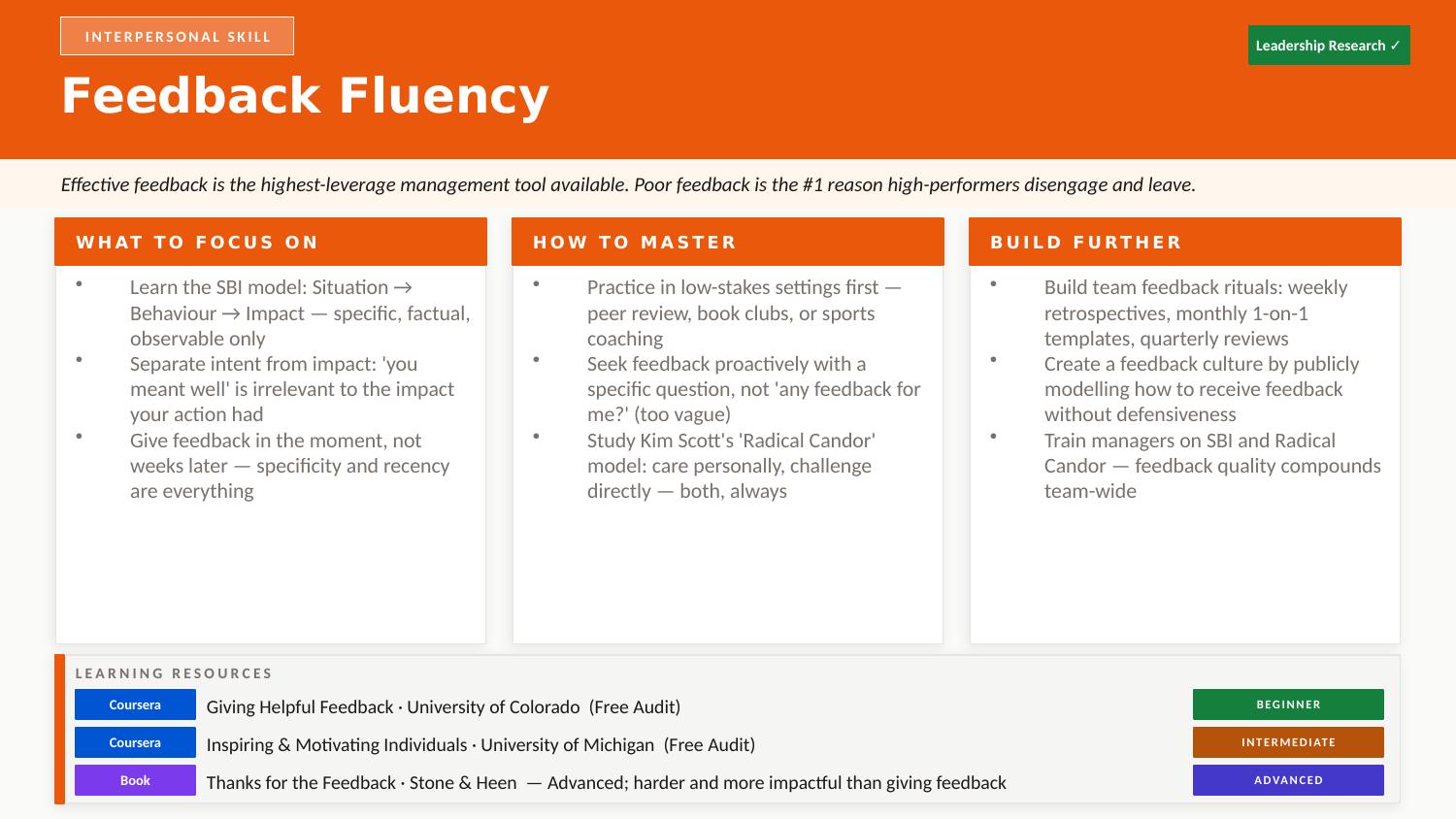
Feedback fluency is the ability to give, receive, and act on feedback without ego interference. Most organisations say they value feedback but have cultures where it rarely happens well. The people who can deliver honest assessment with care, receive difficult feedback without defensiveness, and build feedback loops into everyday work are significantly more effective — and make the teams around them more effective too.
Emotional Vulnerability
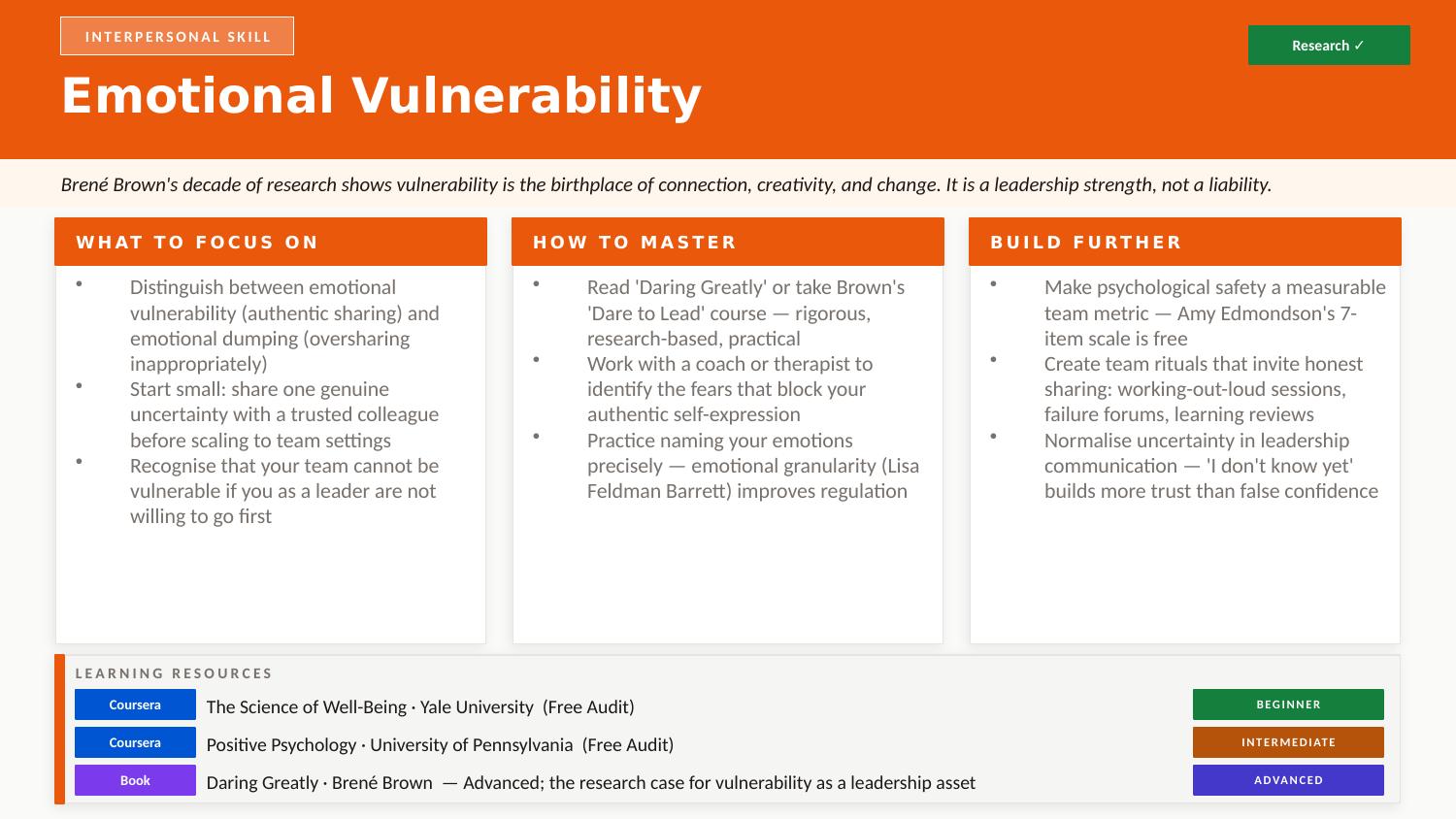
Emotional vulnerability is the willingness to admit uncertainty, acknowledge mistakes, and show up as a full human being in professional contexts. This is different from oversharing. It’s the courage to say “I don’t know,” “I got that wrong,” or “this is hard” — and in doing so, create the psychological safety that allows teams to do their best work. AI cannot model vulnerability. Leaders who can are rare and disproportionately effective.
Conflict Resolution
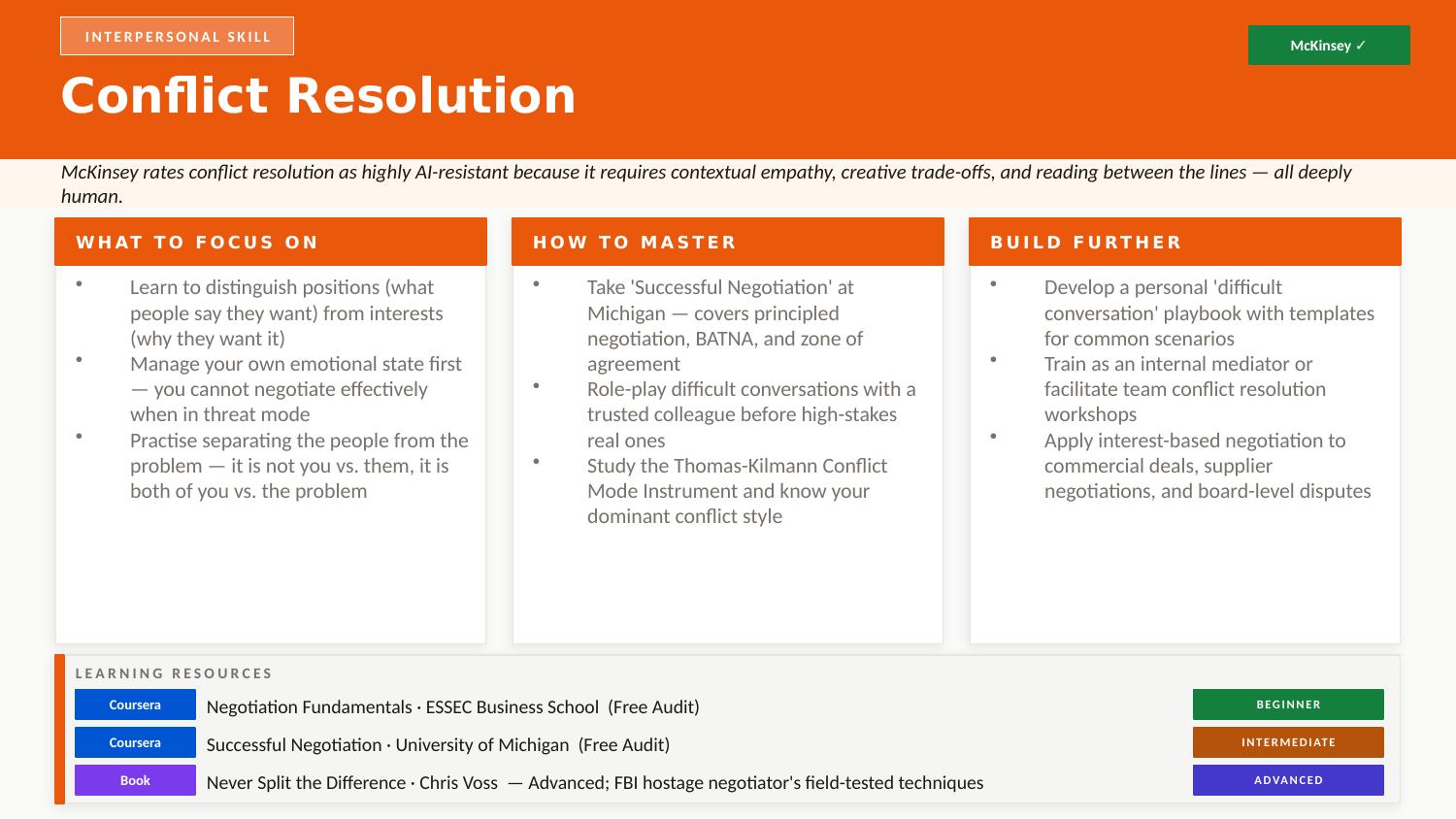
Conflict is not the problem — unresolved conflict is. The ability to navigate disagreement, surface the underlying interests beneath stated positions, and find workable outcomes without destroying relationships is essential in any organisation dealing with change. As AI accelerates the pace of change, the frequency and intensity of conflict around priorities, roles, and resources will increase. The people who can move through it constructively are invaluable.
Part 3 — Leadership & Character Traits
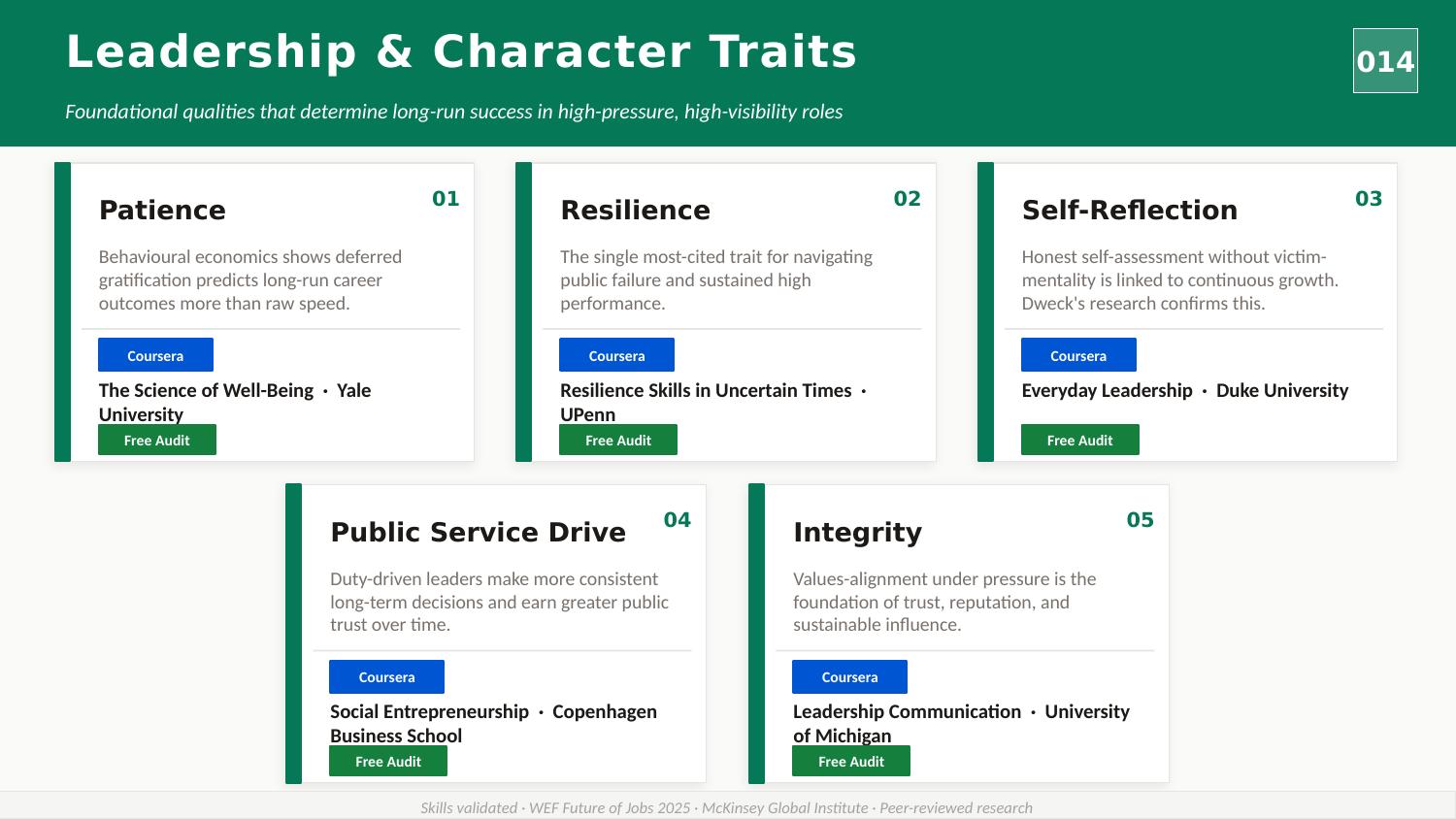
Five leadership traits define the character dimension of effectiveness. These are not competencies you can train in a weekend — they develop through sustained practice, reflection, and deliberate choices over time. They are also increasingly rare, and therefore increasingly valuable.
Patience
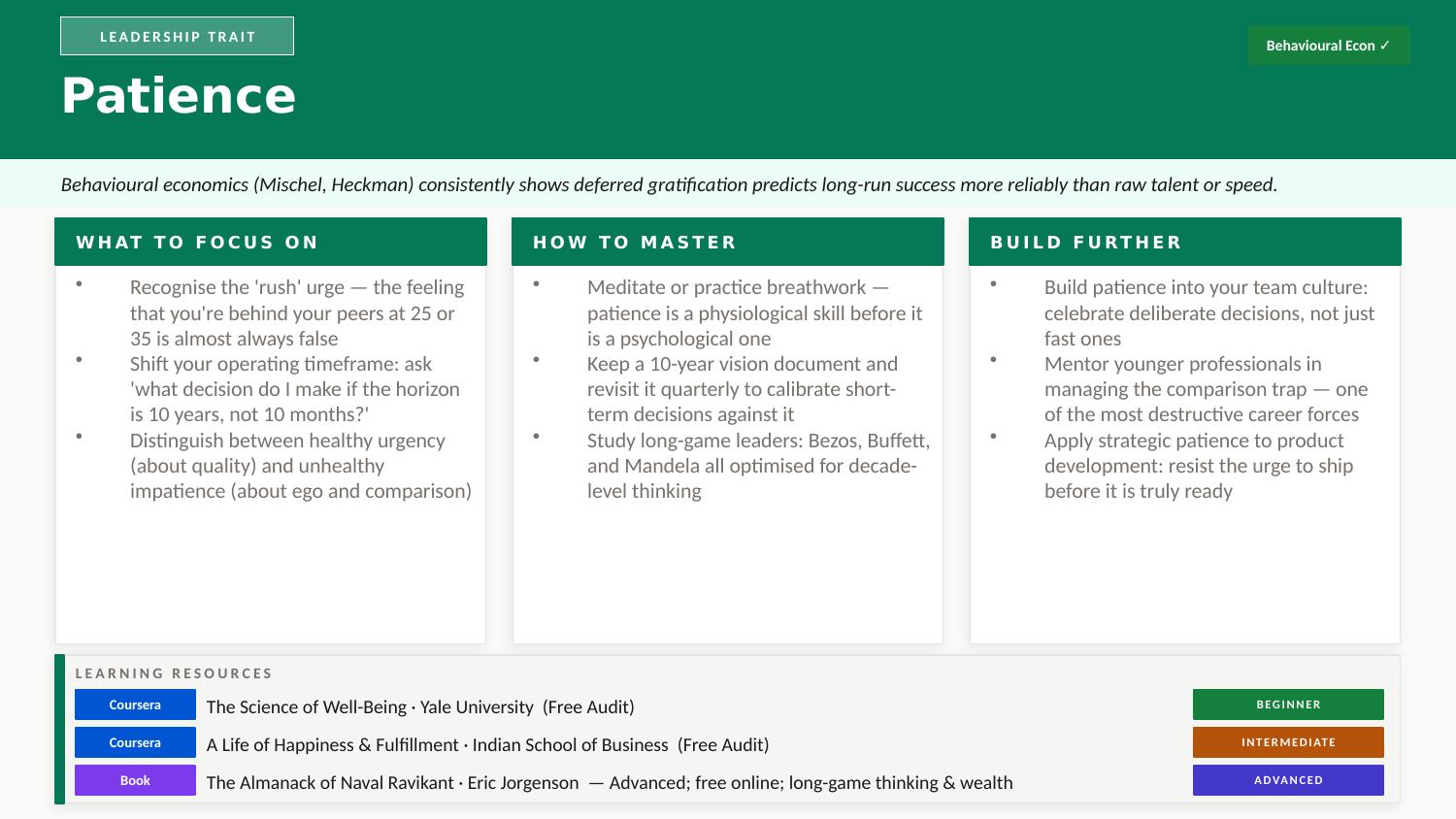
Patience is the capacity to maintain focus and composure in the face of delays, ambiguity, and setbacks — without becoming disengaged or reactive. In environments of rapid change, impatience is expensive: it leads to premature decisions, burned relationships, and abandoned initiatives just before they would have worked. Patience is not passivity; it’s the ability to sustain effort through the parts of the process that feel unproductive.
Resilience
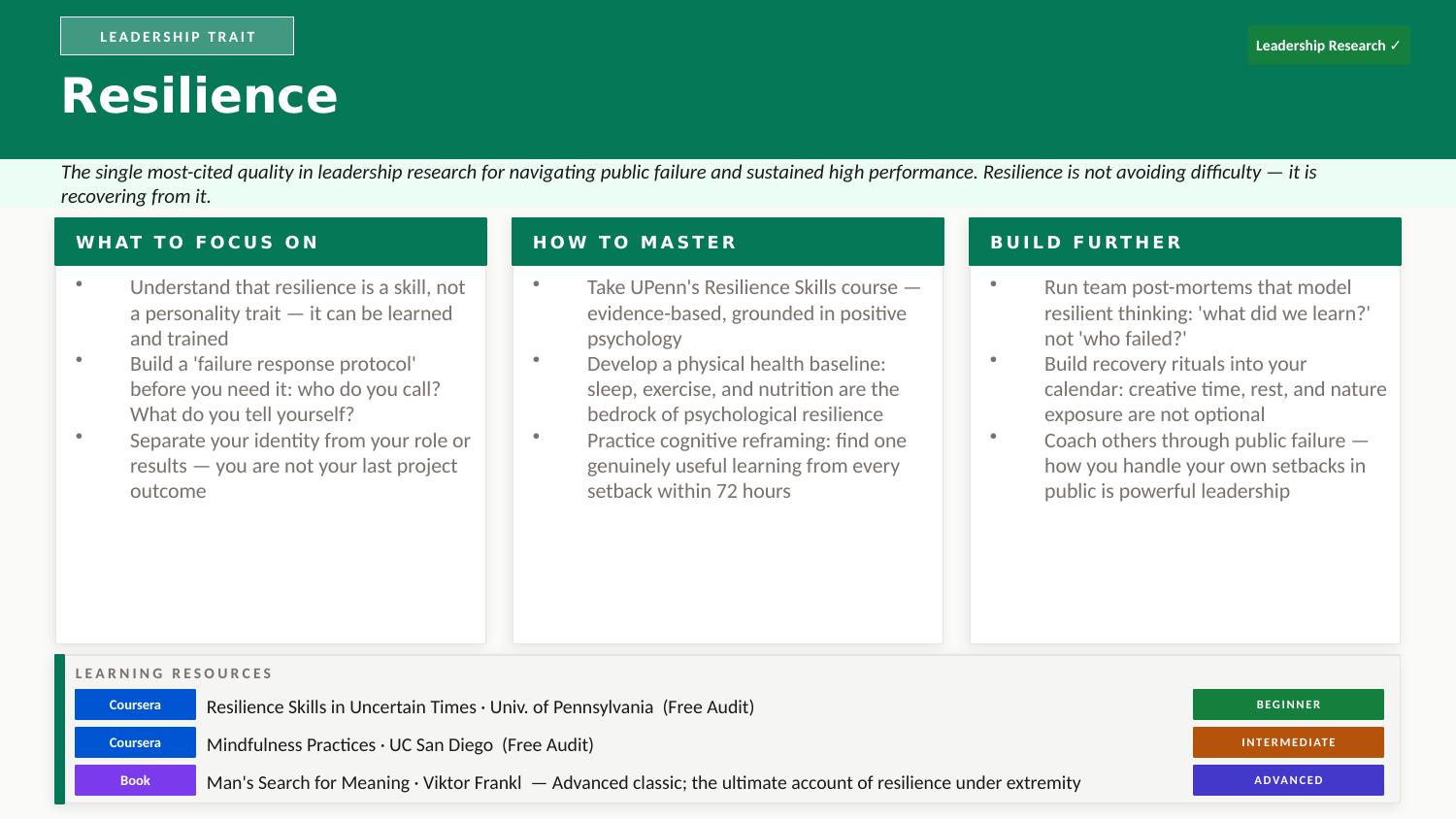
Resilience is the ability to recover from setbacks, adapt to change, and keep going under sustained pressure — without losing effectiveness or identity. The pace of change in AI-adjacent industries means that failure, revision, and disruption are constant features of the work. Resilience is what separates people who iterate from those who stall. It can be built: through deliberate recovery practices, social support, and a relationship with failure that treats it as information rather than verdict.
Self-Reflection
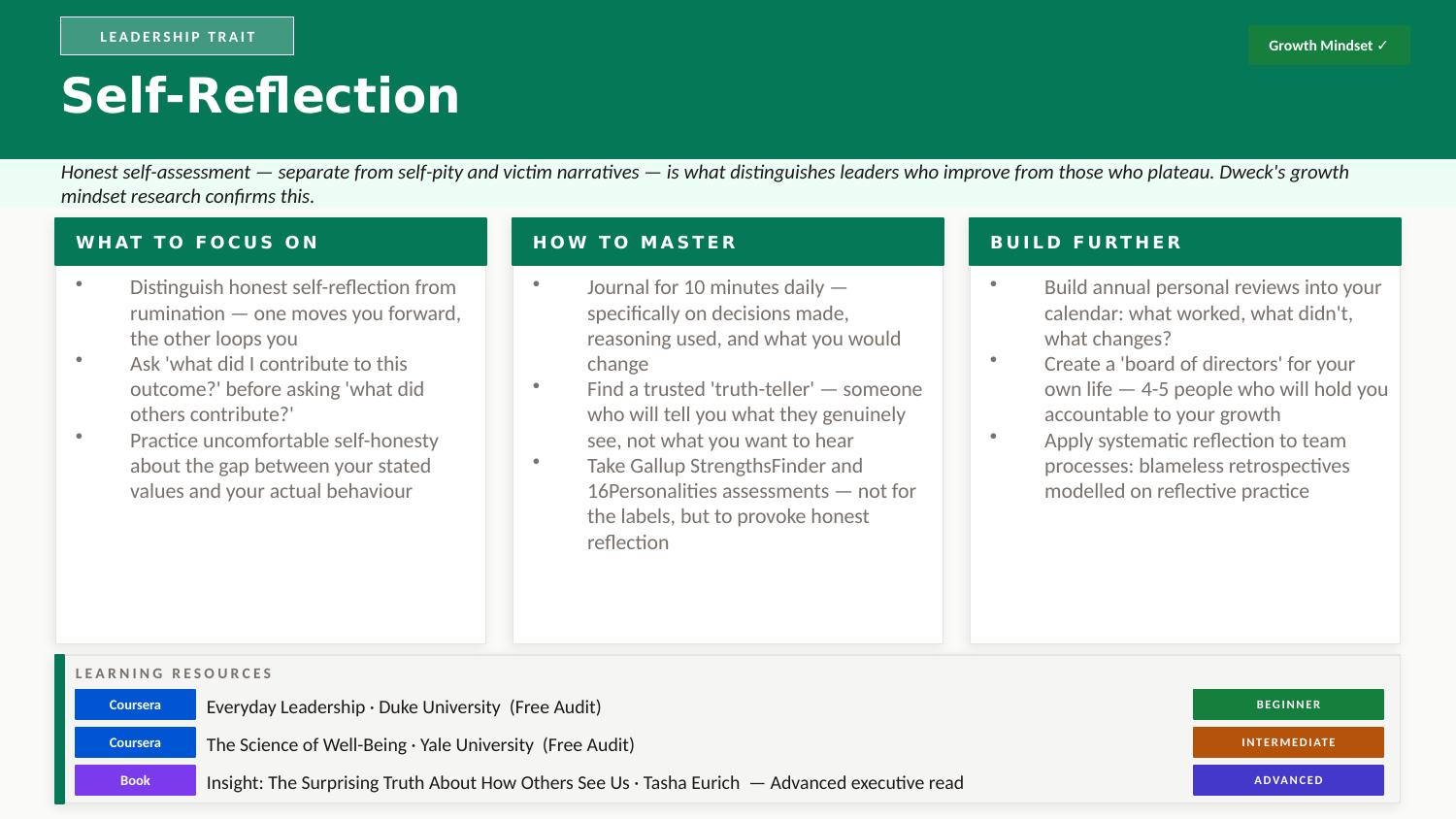
Self-reflection is the regular practice of examining your own behaviour, decisions, and impacts — not to judge but to learn. Leaders who reflect are more consistent, more honest about their limitations, and more capable of genuine growth. In an environment where AI can surface patterns in your work that you would never notice, the people with strong self-reflection practices will use those insights productively rather than defensively.
Public Service Drive
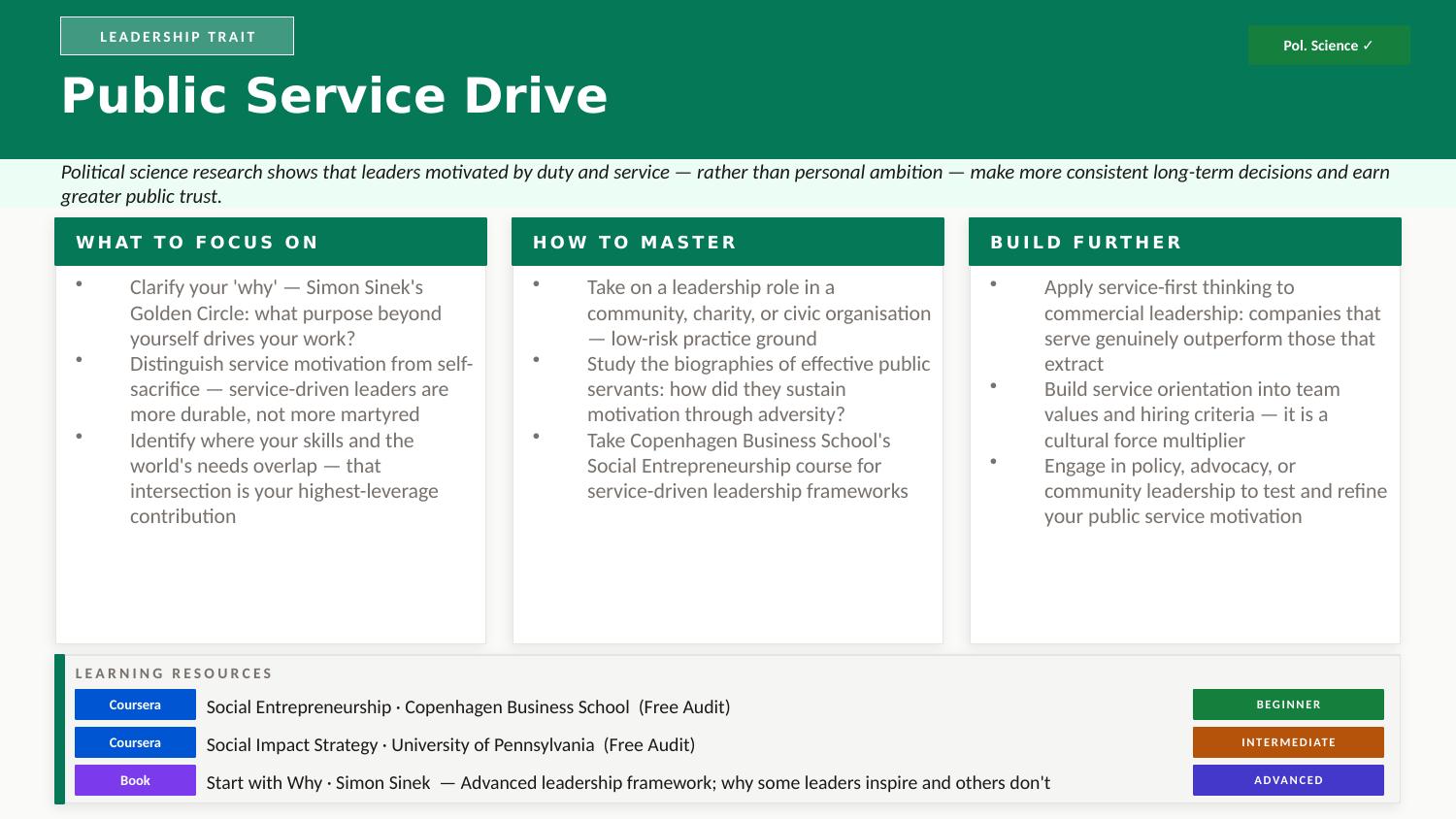
Public service drive is the motivation to contribute beyond personal gain — to the organisation, the community, or the broader world. This is increasingly relevant as AI raises the stakes for decisions about automation, displacement, and the ethical use of technology. People who are driven by purpose beyond their own advancement make different choices, communicate differently, and attract different levels of trust from the people around them.
Integrity
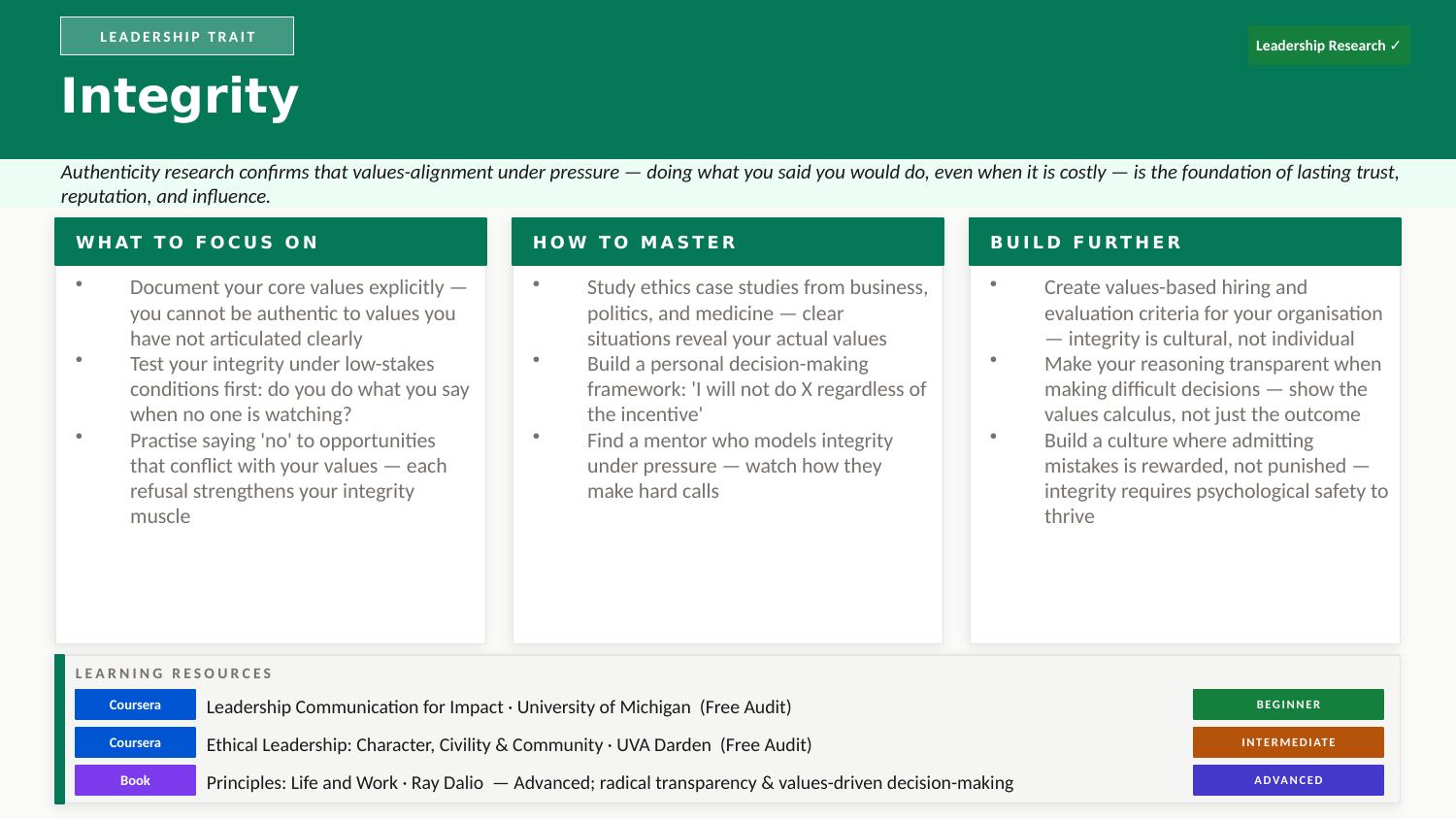
Integrity is the alignment between your values and your actions — and the willingness to maintain that alignment when it’s costly. As AI systems enable new forms of data manipulation, synthetic content, and opaque decision-making, integrity becomes a competitive differentiator. Organisations that can demonstrate trustworthiness will command a premium. The people inside those organisations who model integrity shape the culture that makes that trustworthiness real.
Part 4 — Technical AI Skills
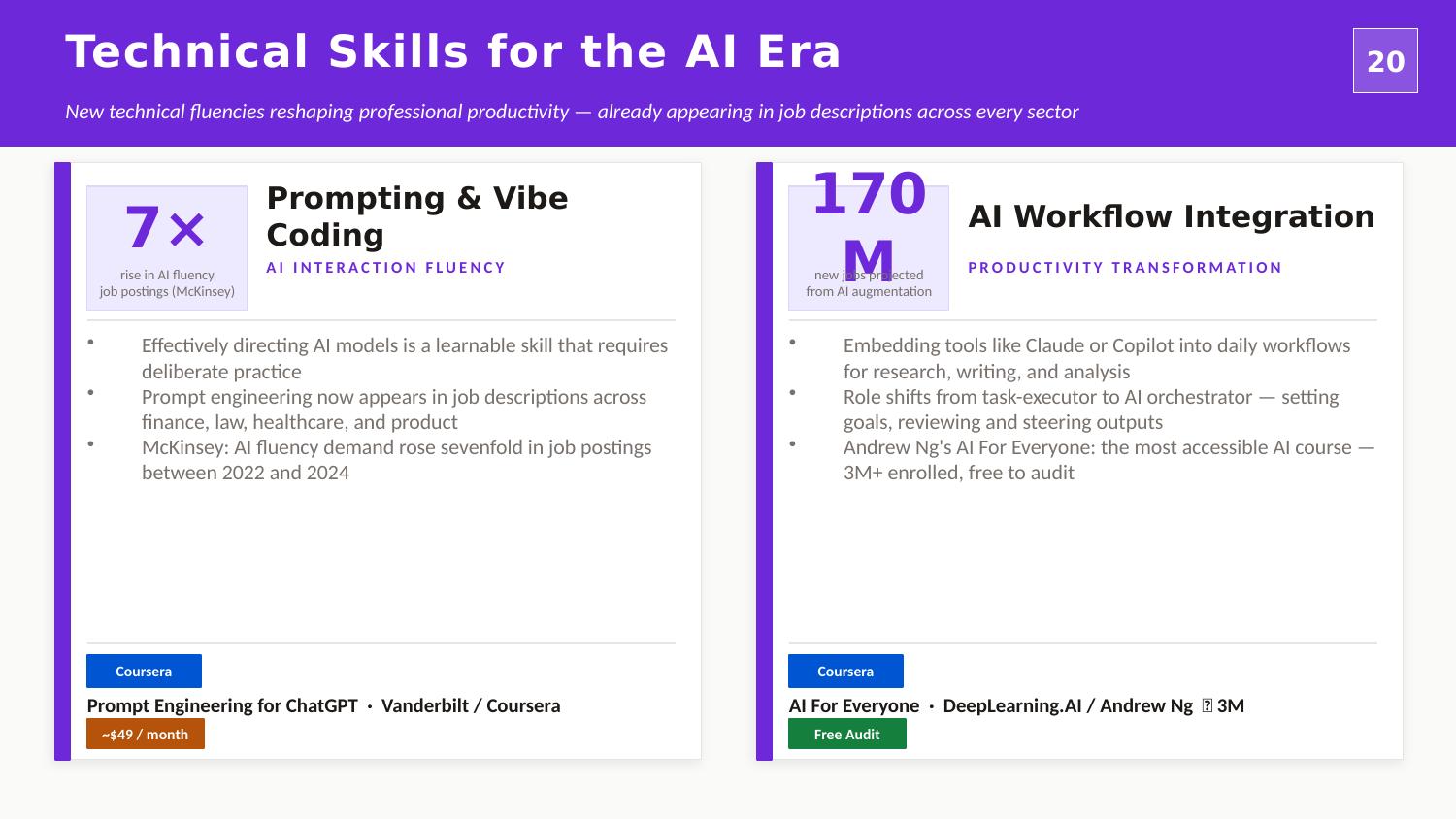
Two technical skills round out the framework. These are the most rapidly evolving — and the ones with the clearest immediate return on investment. Job postings referencing AI fluency rose 7x between 2022 and 2024. The WEF projects 170 million new roles that require humans to collaborate effectively with AI systems. The floor for technical AI competence is rising.
Prompting & Vibe Coding
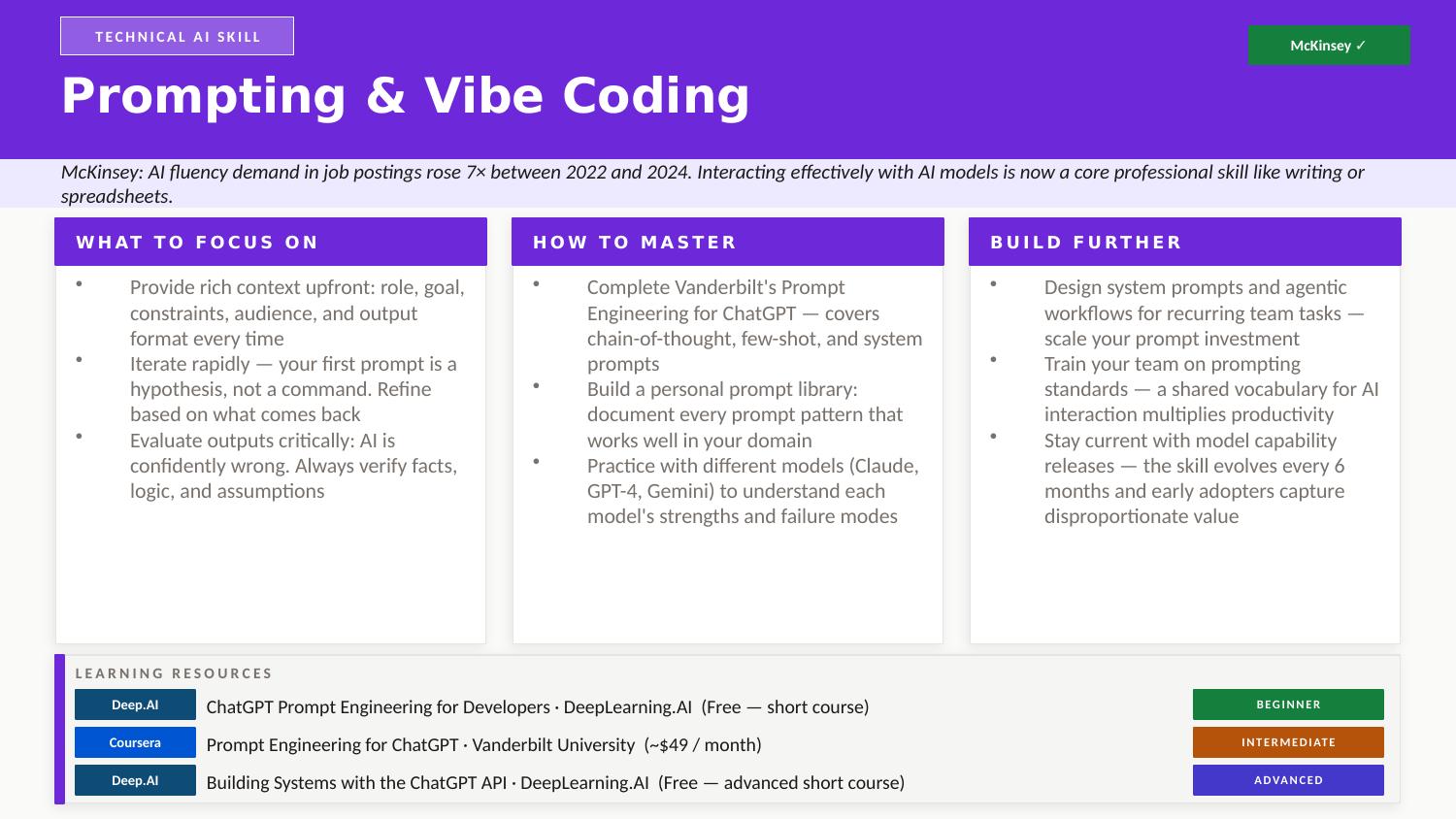
Prompting is the ability to communicate effectively with AI systems to get useful, accurate, and appropriately scoped outputs. This is not a trivial skill — it requires understanding how language models interpret instructions, how to provide context, how to structure multi-step tasks, and how to verify outputs critically. Vibe coding extends this to software development: describing what you want in natural language, iterating with an AI model, and producing working code without traditional programming expertise. Both capabilities are now teachable, testable, and directly applicable to most knowledge-work roles.
AI Workflow Integration
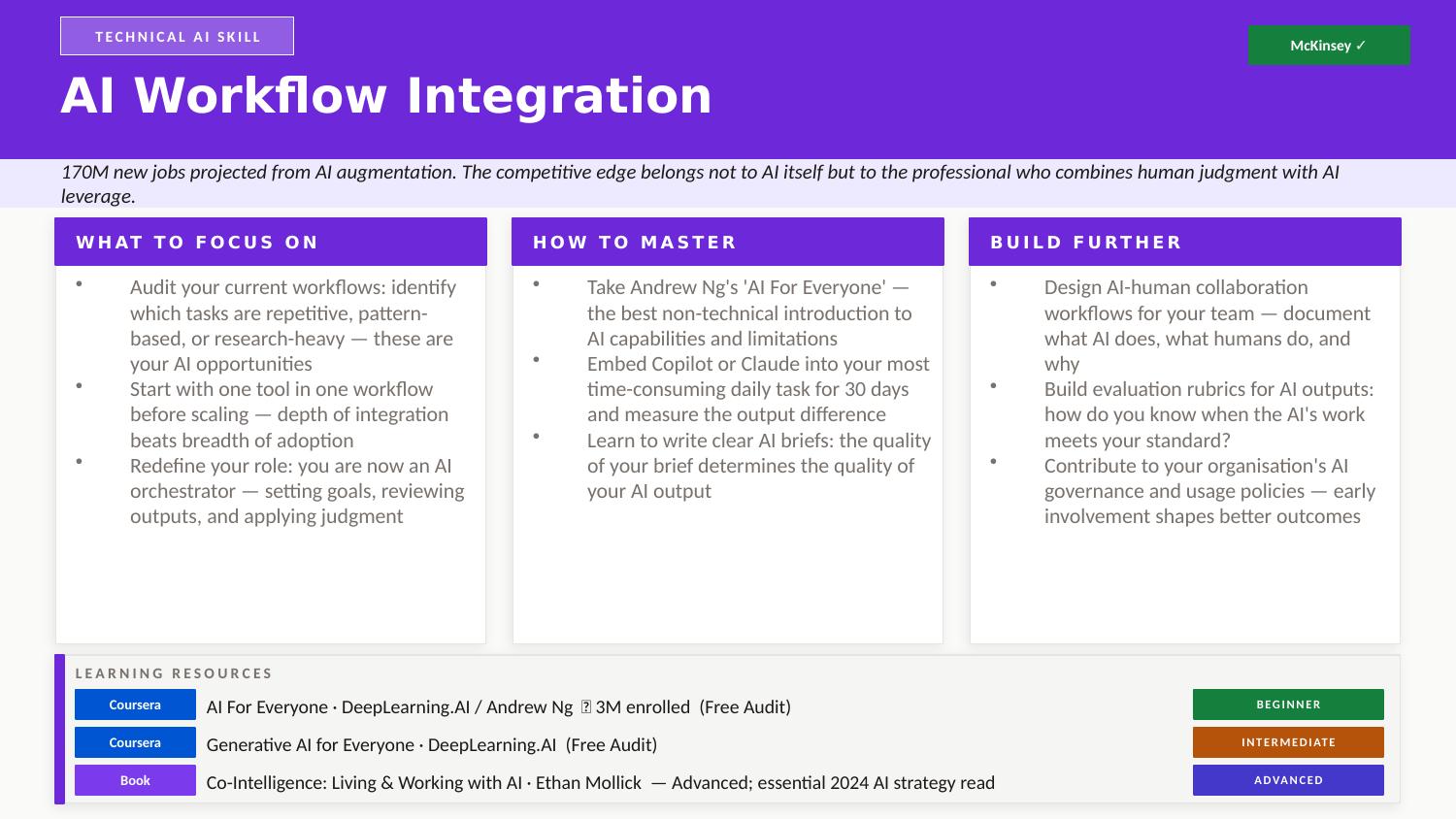
AI workflow integration is the ability to identify where AI can improve or replace steps in an existing process — and then actually implement that change. This requires both the technical literacy to understand what tools can do and the process thinking to redesign workflows around them. The people who are most effective here are not necessarily the most technically sophisticated; they are the ones who understand the work deeply enough to see where the leverage is.
Where to Start: Free Learning Paths
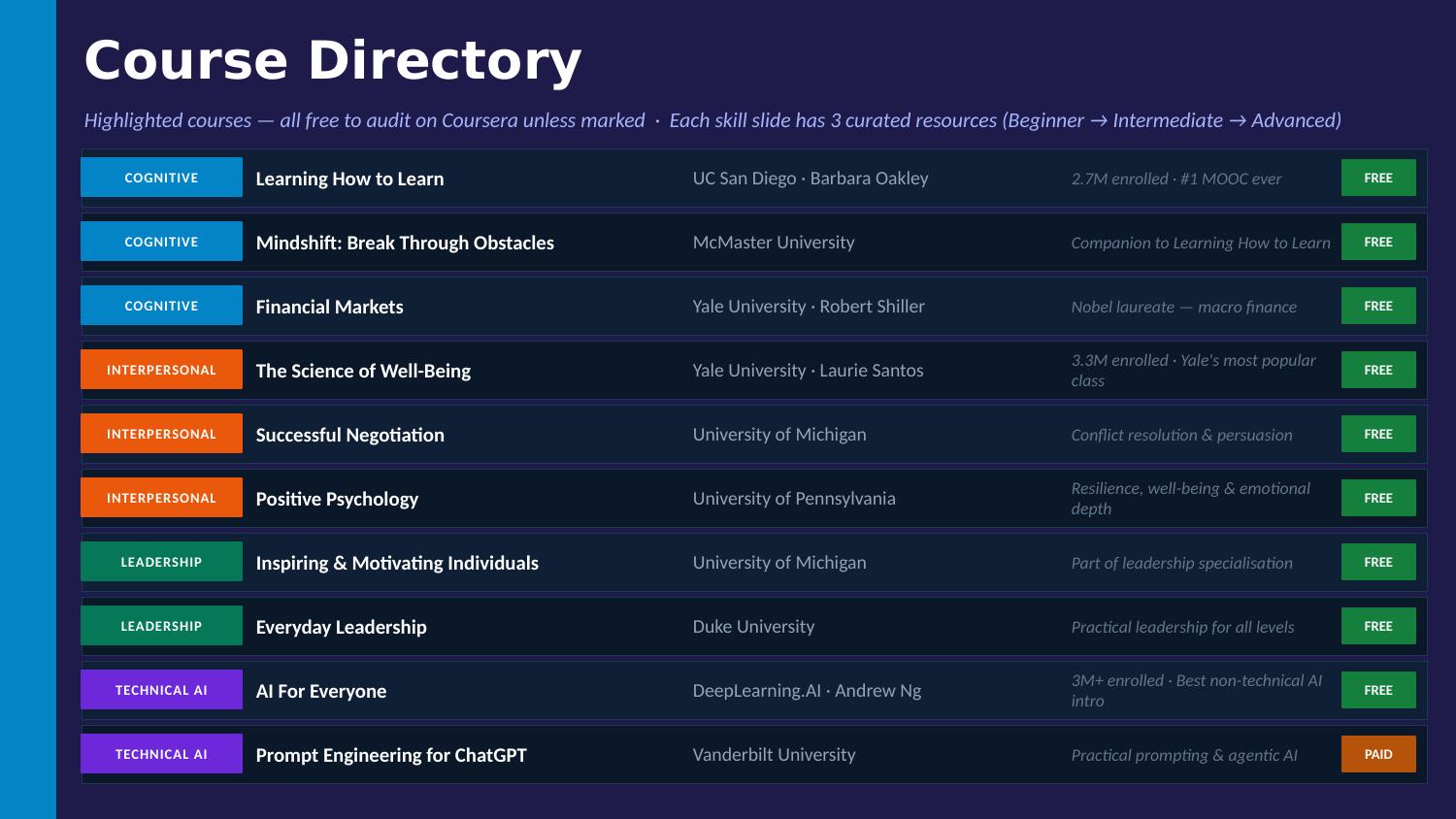
The final slide is a course directory — every course listed is free to audit on Coursera, mapped to the skill categories above. The path from “aware of these skills” to “actively developing them” starts with picking one. Not the most impressive one. The one that feels most relevant to where you’re working right now.
The Summary
The 17 skills above are not a checklist for becoming superhuman. They are a map of where the real work is — the capabilities that AI cannot replicate, that organisations are actively competing for, and that compound over time in ways that technical knowledge alone does not.
The division is useful: Cognitive skills shape how you think. Interpersonal skills shape how you connect. Leadership traits shape who you are under pressure. Technical AI skills shape how you extend your own capabilities. All four matter. The people who develop all four will have a meaningful advantage — not despite AI, but because of it.
The tools are available. The research is clear. The only question is where you start.
Sources: World Economic Forum Future of Jobs Report 2025; McKinsey Global Institute Workforce Transition Research; peer-reviewed literature on human skills in AI-augmented workplaces.
Credit: Idea for this presentation inspired by this podcast.
Test what you read
Quick quiz

About the Author
Ajay Walia
AI {IT Architect} focusing on local-first multi-agent AI engineering, zero-data-egress systems. Ideator, Creator and Executor on Curious Bit.
Keep Reading
About
Learner 🎓 · Negotiator 🤝 · Architect 🏗️ · Implementer 👷 · Surviving — enabled by AI. Currently exploring: AI, Hybrid Cloud, Automation, Networks, Digital Workplace<br><br><em>"He who thinks he knows, knows not.<br>He who knows that he does not know, knows."</em>
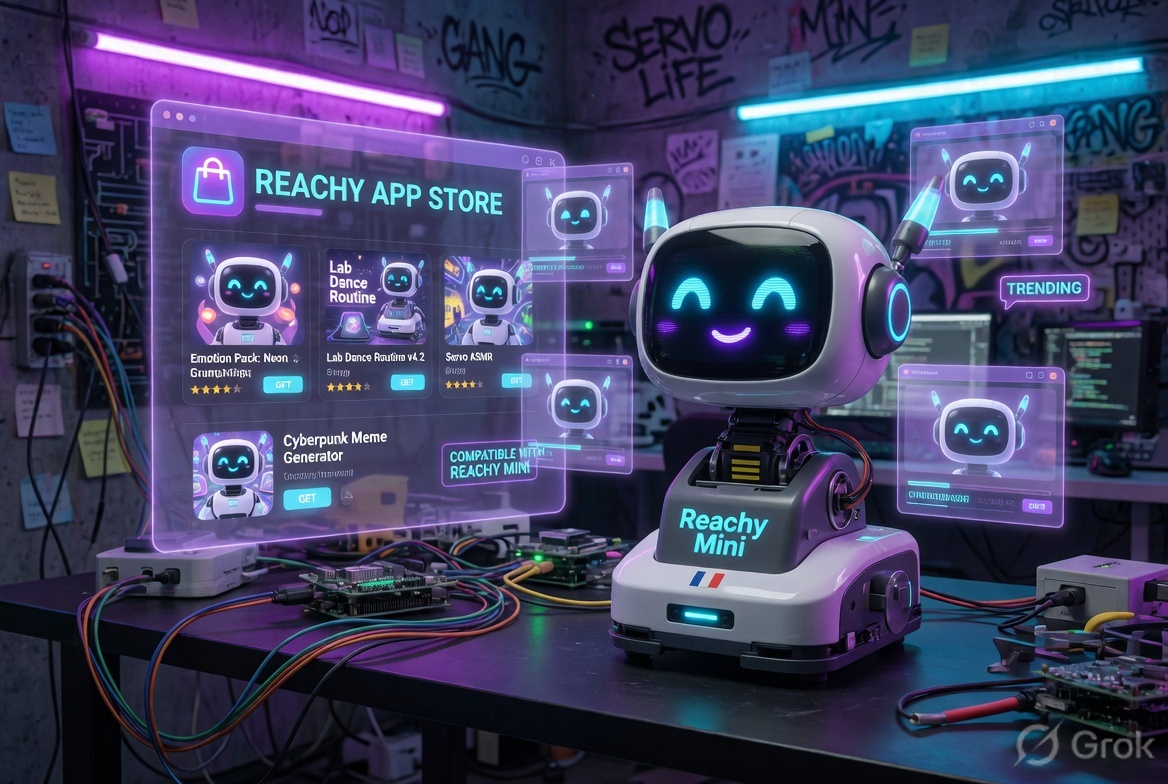
Reachy Mini Is a $299 Open-Source Robot With a Hugging Face App Store — And 10,000 People Already Have One
Pollen Robotics and Hugging Face just shipped an agentic app store for Reachy Mini — a desktop robot you assemble yourself, control with Python, and extend with AI apps built in plain English. Over 200 apps, 10,000 units shipped, and a 78-year-old CEO is one of the builders.
I Built a Team of IT Architects using LLM That Live on MacBook — Meet Aether
How I built Aether — a local-first, multi-agent AI system that runs 10 specialist IT architecture advisors on a single MacBook M5 Pro, with no cloud, no API costs, and zero data egress.