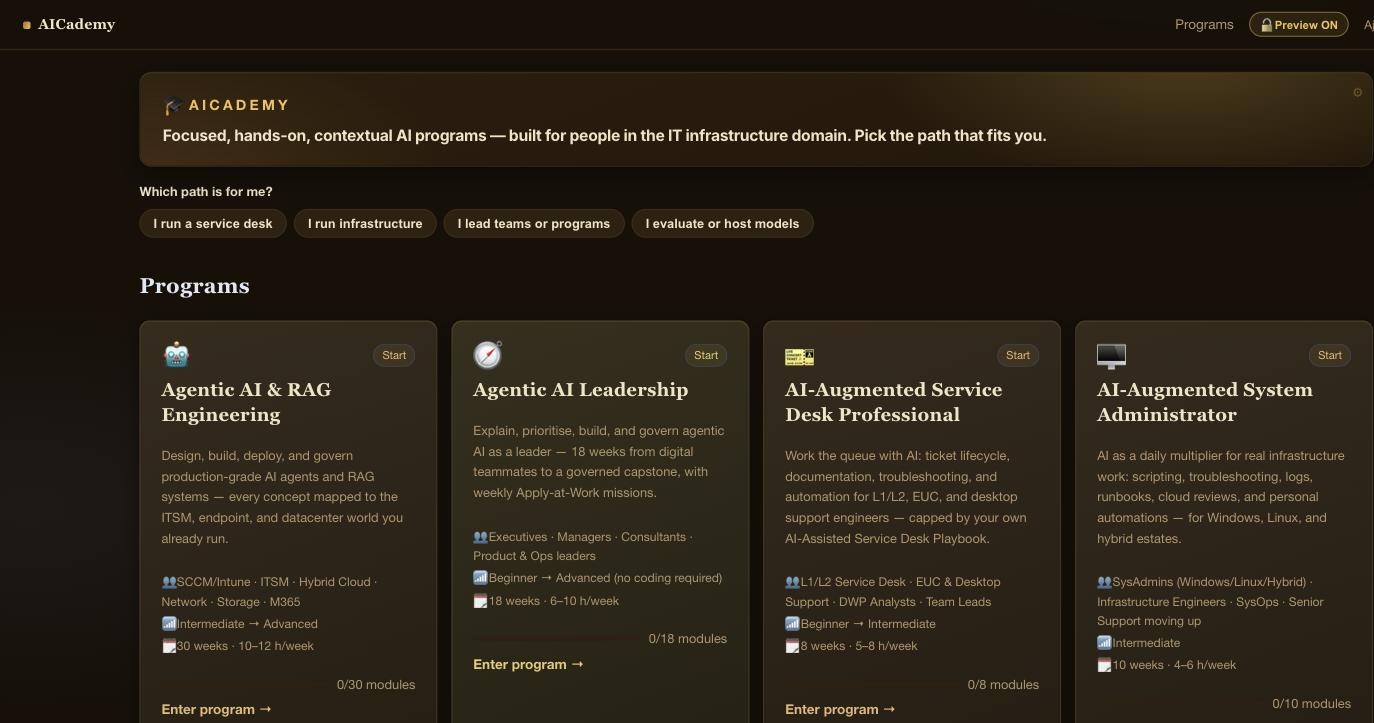
Six courses. 82 modules. Built for IT engineers who work in the infrastructure domain — service desk, L1 / L2 / L3 engineers (workplace & datacenter), architects, leads, project managers — focused and contextualised for the ecosystem these people operate in.
AICademy is a free, self-paced learning platform with six hands-on AI programmes for infrastructure and workplace professionals. Every module drops you into a simulated employer — a real stack, a real ticket queue, named colleagues — and reframes each AI concept through the lens of the job you already do. It's React + Vite, Supabase, and a Netlify-hosted AI tutor grounded in the course itself. This part covers the why, the what, and the differences. Part 2 covers how it was built.
If you work in infrastructure support at a global systems integrator — TCS, HCL, Infosys, Wipro, Cognizant, Capgemini — you have almost certainly been told, more than once this year, to "upskill in AI." You have probably also opened one of the recommended courses, watched forty minutes of someone training a sentiment classifier on a movie-review dataset in a Jupyter notebook, and quietly closed the tab.
Not because it was bad. Because it was for someone else.
There is a large, capable, and strangely underserved population of technologists: the people who run Intune and SCCM estates, work ServiceNow queues, patch Windows and Linux fleets, manage M365 tenants, run transitions and migrations, and hold P1 bridges together at 2am. They keep the lights on for the Global 2000. And when they go looking for AI education, they are offered one of two things — a data science curriculum that assumes Python and linear algebra, or a corporate LMS module that is mostly a compliance video with a quiz.

That gap is not a small one. Infrastructure support is exactly where agentic AI is landing hardest and fastest — ticket deflection, automated triage, self-healing endpoints, AI-drafted knowledge. The people closest to that change have the least education designed for them. Being closest to the disruption and last in line for the training is a bad place to stand.
So I built the thing I couldn't find.
The whole platform rests on one conviction, and it's worth stating plainly because it shapes every design decision underneath it: AI is not coming to replace the infrastructure engineer. It is coming to rewrite what the infrastructure engineer does all day. The people who understand that early — and can prove it with artifacts — are the ones who move up. The people who wait to be told are the ones who get restructured around.
Three principles follow from that.
A course for service-desk engineers should not explain "hallucination" with a poem-writing example. It should explain it the way it will actually bite you: an LLM is one more confident witness, exactly like the user who swears they "didn't change anything." You already have a professional instinct for confident-but-wrong information. The course connects the new concept to the instinct you already own.
Every module ends with something you did, not something you saw. There is a project, a set of drills, and an Apply-at-Work mission — a task performed in your actual job that week, on real (sanitised) tickets, real logs, a real status report. Learning that never leaves the browser doesn't survive contact with Monday.
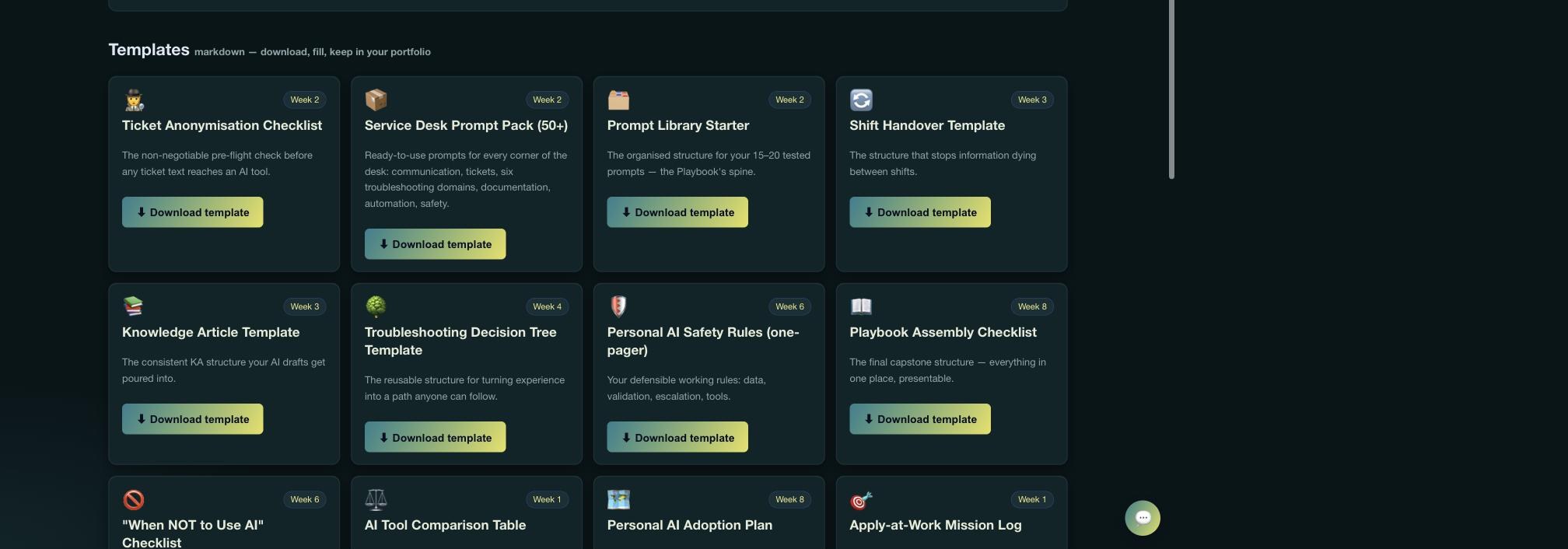
Roughly a third of the content is about when not to use AI: anonymisation before any ticket text is pasted, validating generated scripts before they touch production, knowing which decisions must stay human. An AI course for people with production access has an obligation to teach restraint, not just capability. There is a downloadable template in the Service Desk course literally called "When NOT to Use AI" Checklist.
This is the piece I'm proudest of, and the one that most clearly separates AICademy from everything else on this list.
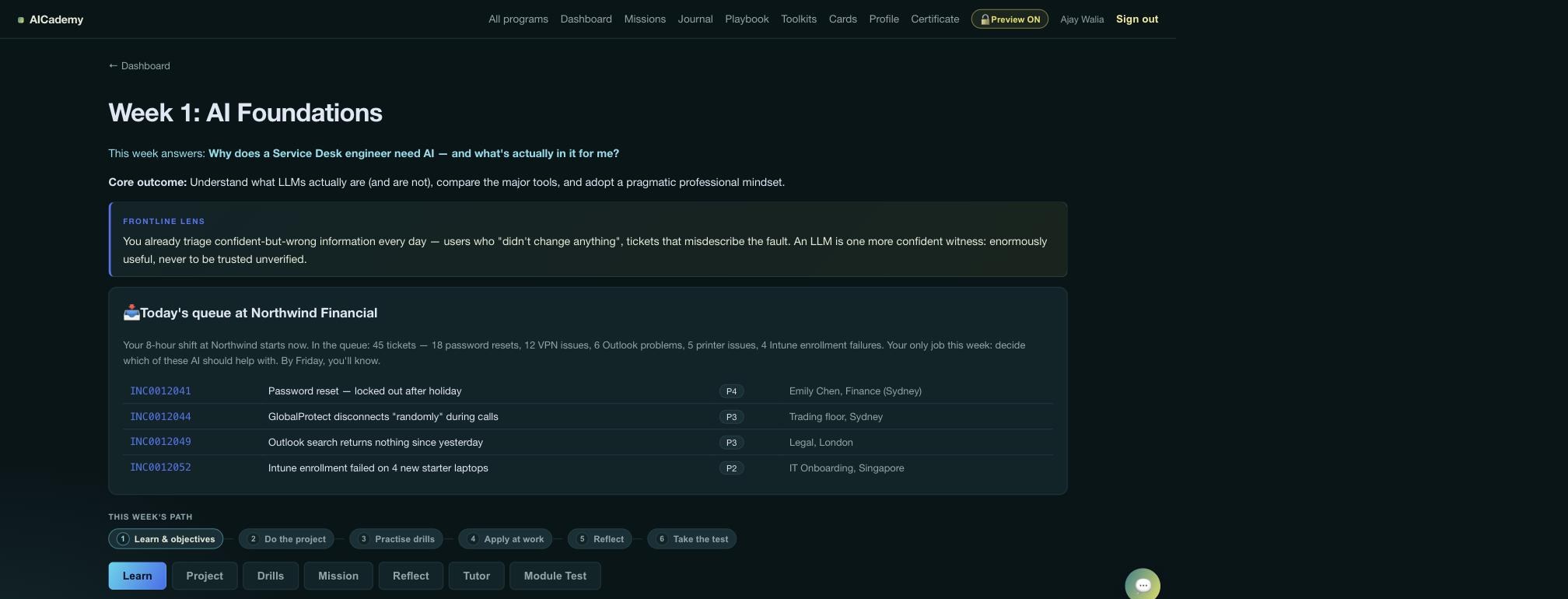
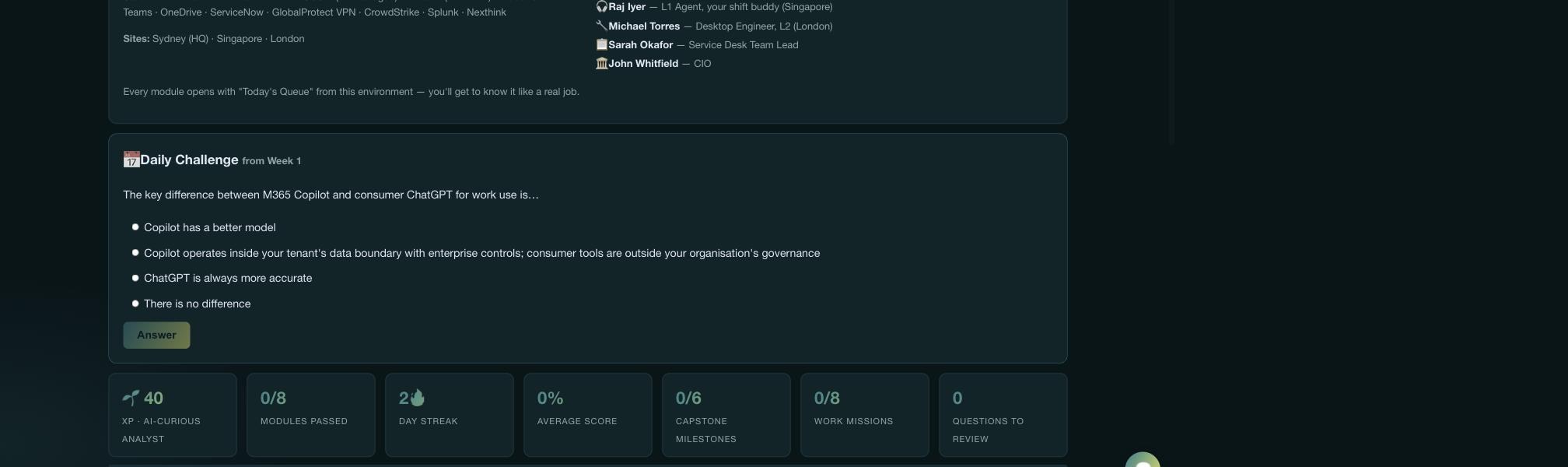
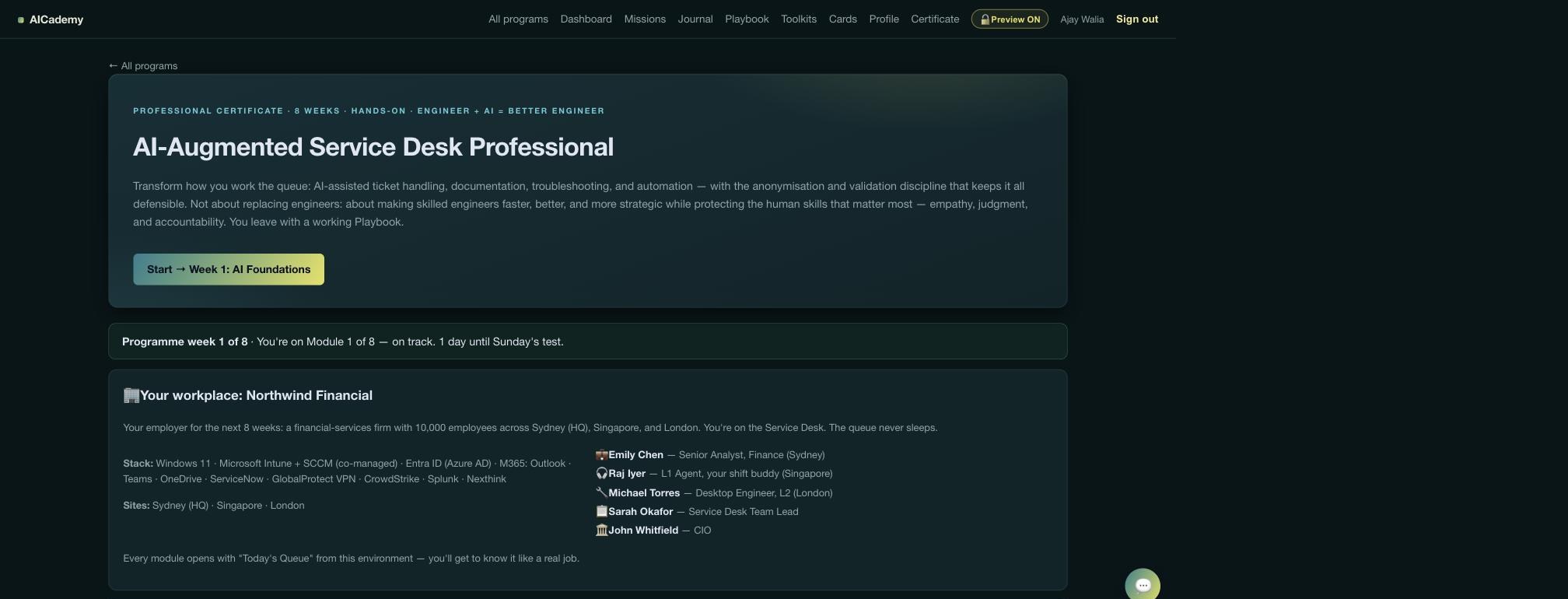
When you open the Service Desk programme, you are not shown a syllabus. You are shown your new employer: Northwind Financial, a 10,000-employee financial-services firm with offices in Sydney, Singapore and London. You're on the Service Desk. The queue never sleeps.
You get the stack you'll be supporting for the next eight weeks — Windows 11, Intune + SCCM co-managed, Entra ID, M365, ServiceNow, GlobalProtect VPN, CrowdStrike, Splunk, Nexthink. And you get colleagues, with names and personalities:
Four of the six courses have a world like this, each matched to its discipline — Northwind Financial for the service desk, Meridian Logistics for the sysadmin, Northgate Retail Group for the project manager, Alderbrook Health for the model-internals course. The characters recur. The environment persists. By week six you know that estate the way you know a real account.
Every single module then opens with Today's Queue from that environment. Not an abstract exercise. A shift:
That lens callout changes name by course, because the reframing is the whole point. The same underlying concept arrives as a Frontline lens for the service desk, an Ops lens for the sysadmin, a Delivery lens for the PM, an Infra lens for the RAG engineer, a Leadership lens for executives, and a Decision lens for the model-internals course. Six audiences, six vocabularies, one idea.
The courses are deliberately pitched at different rungs of the same ladder. You join where your job is now — nobody has to start at the bottom.
Work the queue with AI: ticket lifecycle, documentation, troubleshooting, automation — with the anonymisation and validation discipline that keeps it defensible. Ends with your own AI-Assisted Service Desk Playbook.
AI as a daily multiplier on real infrastructure work: scripting, troubleshooting, log analysis, runbooks, cloud cost and config reviews, personal automations. Generated fast, validated always.
An AI co-pilot across the delivery lifecycle: charters and WBS, risk registers, stakeholder comms, scope and change control, status reporting, cutover readiness and hypercare.
The deep build. RAG from scratch, embeddings and vector stores, tool-calling agents, memory, LangGraph, multi-agent systems, MCP servers, observability, cost engineering, CI/CD. Every concept mapped to the estate you already run. Ranks you from L1 Service Desk to Agentic AI Engineer.
No coding required. Explain, prioritise, build and govern agentic AI as a leader — from digital teammates to vibe-coded internal tools to a governed capstone. Weekly Apply-at-Work missions in your real organisation.
What LLM weights actually are, where they live, how they change, and what they cost to run — for the people who have to size the box, vet the file, and defend the bill. Infrastructure experience assumed; no maths background required.
Two more are queued: Copilot & M365 AI for the Workplace and AI Security & Governance for Enterprises.
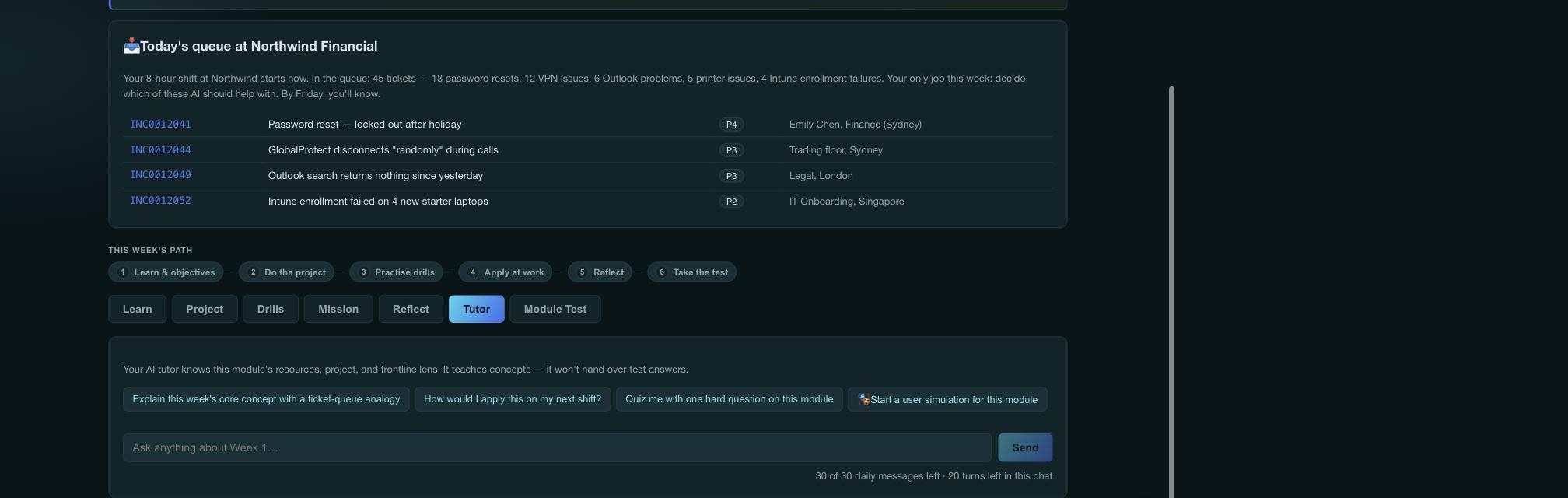
Every module in every course runs the same loop. The consistency is deliberate: once you learn the rhythm in week one, you never spend attention on navigation again — all of it goes to the content.
The week opens as a question, not a topic — "Why does a Service Desk engineer need AI, and what's actually in it for me?" — followed by a single core outcome and curated resources. Then the discipline lens reframes it in your language.
A build task scoped to the week and graded against a rubric. Not a toy: the outputs are the raw material of your capstone artifact. In the Service Desk course these accumulate into a Playbook; in RAG Engineering they accumulate into a deployed, observable agent system.
Short repeatable exercises that build fluency — prompt patterns, failure spotting, tool selection. Drills are where the muscle memory forms, and they feed a spaced-repetition review queue so what you learned in week two is still there in week seven.
The mission — the part that makes this a professional programme rather than a course. A specific task performed in your real job that week, with real (sanitised) data, and a colleague to show it to.
A written journal entry: what worked, what the AI got wrong, what you'd do differently. This is the step most platforms skip, and it's the one that converts activity into judgment. Your journal becomes evidence of how your thinking changed over eight weeks.
A module test that must be passed to advance, plus optional boss battles — harder multi-concept challenges worth bonus XP. Progress is gated on demonstrated understanding, not on video minutes watched.
Every module has an AI tutor that already knows the module's resources, project, and lens — and is explicitly instructed to teach concepts rather than hand over test answers. It can also run a user simulation: role-play an end user so you can practise the conversation, not just the fix.
Beyond the weekly loop, each course carries a toolkit of downloadable markdown templates — the artifacts that outlive the course and go straight into your working life or your portfolio.
The architecture is boring on purpose. One repo, one deployment, one website; every course is a folder. Adding a course means creating a data directory and registering it in one file — the homepage card, routes, progress tracking, XP, certificates, tutor and flashcards all light up automatically.
A few choices worth calling out, because they were arguments I had with myself:
Content as code, not a CMS. Every course is plain JavaScript data files in the repo. That means the curriculum is versioned, diffable, reviewable in a pull request, and impossible to lose to a database migration. It also means writing a course feels like engineering, which — for this material — is the correct feeling.
Retrieval that runs in your browser. The in-app assistant does TF-IDF lexical retrieval over the course corpus — modules, lenses, resources, rubrics, quiz explanations, missions and published notes — entirely client-side. No vector database, no per-query cost, no data leaving the machine. It is, fittingly, the "naive RAG" that the flagship course teaches you to build in week six.
Offline by default. Supabase handles auth and cloud sync when it's configured; when it isn't, everything falls back to localStorage and the whole platform still works. A PWA manifest and service worker mean a learner on a bad connection — or on a locked-down corporate laptop — still gets the course.
I want to be fair here: the big platforms are excellent at what they do. Coursera and DeepLearning.AI produce world-class material. The difference isn't quality — it's who the material assumes you are, and what it expects you to do with it.
| Typical online AI course | AICademy | |
|---|---|---|
| Assumed learner | Developer or aspiring data scientist; Python and notebooks assumed | Infrastructure support professional; ServiceNow, Intune and PowerShell assumed instead |
| Examples | Movie reviews, iris datasets, chatbot toy apps | A live ticket queue, a failing Intune enrollment, a cutover at 02:00, a cloud bill you have to defend |
| Environment | A fresh, contextless exercise each lesson | One persistent simulated employer per course — same stack, same colleagues, for the whole programme |
| Practice | Quizzes and sandboxed labs that end at the browser | Weekly Apply-at-Work missions performed on real work, shown to a real colleague |
| Safety content | A disclaimer slide about hallucination | Anonymisation checklists, script-validation workflows, "When NOT to Use AI", a personal AI usage policy you write and reconcile with your employer's |
| Support | A forum, or a generic chatbot with no course context | A tutor scoped to that module's resources, project and lens — that refuses to hand over test answers, and can role-play an end user |
| Output | A completion certificate | A working artifact — Playbook, runbook set, PM system, deployed agent — plus measured before/after numbers from your own job |
| Motivation model | Video progress bar | XP, ranks, streaks, badges, boss battles and a spaced-repetition review queue |
| Cost | Subscription or per-certificate fee | Free, self-paced, and it works offline |
The rank ladder in the flagship course makes the intent explicit. It runs L1 Service Desk → Desktop Support Engineer → Sysadmin → Endpoint Engineer → Platform Engineer → Hybrid Cloud Architect → Automation Lead → AI Ops Engineer → Agentic AI Engineer. That's not a gamification gimmick. That's the actual career staircase in a GSI, with the last two rungs added — the two that didn't exist five years ago and now command the premium.
This is the question I held every design decision against. Not "what will they have watched" — what will have changed. Six answers:
A Playbook, a runbook library, a PM system, a deployed agent. Something you can put in front of a manager, a client, or an interviewer and say: I built this, here's how it works.
Week 1 baselines your slowest recurring tasks. The capstone compares them to now. You leave able to say "this saves me N hours a week" and prove it.
You'll know what not to paste, what to validate before it runs, and where the human decision must stay. That's the difference between using AI at work and being trusted with AI at work.
Grounding, retrieval, evaluation, agents, tool calling, governance. When your account starts an AI programme, you're in the room because you can talk about it precisely.
The rank ladder is a career map. It shows the L1 engineer that the path to AI Ops Engineer is a sequence of real steps, not a leap requiring a new degree.
Drills, streaks and a spaced-repetition queue are there so week two survives to week seven — and so the practice continues after the course ends.
Part 1 is the platform as it stands. Part 2 is the rebuild log — every upgrade I shipped after the first version met real learners, and what each one fixed.
If you want to look around before then, the whole thing is live and free — no signup required to browse the courses.
▸ Explore AICademy Read the full course sources
Built by Ajay Walia. If you work in infrastructure at a GSI and something here is wrong about your day-to-day, I want to hear it — that feedback is what the next course gets built from.